
POPULAR ARTICLES
- e-Invoicing in France 2026: Timeline, Requirements, Guidelines & Format
- What is a PDP, OD and PPF in France e-Invoicing?
- All About e-Reporting under France e-Invoicing
- VAT in France 2026: Rates, Registration, Filing, Payments & Penalties
- France e-Invoicing and e-Reporting FAQs: Rules, Scope & 2026 Requirements
- Credit Note in France: Meaning, Usage, Example & Template
- Factur-X in France: What It Is, How It Works and Steps to Generate
- SIREN and SIRET Numbers: How to Apply and Where to Get Them
- Common e-Invoicing Mistakes in France & How to Avoid Them
- XML vs PDF/A-3 in e-Invoicing: Handling Structured & Unstructured Data
- Top 7 Misconceptions About E-Invoicing in France for 2026
- What is the EN 16931 Electronic Invoicing Standard in France?
- Handling Structured & Unstructured Data in e-Invoicing: XML and PDF/A-3 Explained
YOU MIGHT BE INTERESTED IN
B2B e-Invoicing in France: Requirements, Deadlines, and Compliance


B2B e-invoicing in France is related to the use of electronic invoices in a structured format in local transactions by French VAT-registered companies through a special platform. This initiative replaces PDF and paper invoices with structured electronic formats and introduces e-reporting on a phased basis, starting September 2026 for large enterprises and ETIs, and September 2027 for SMEs and micro-enterprises.
Key Takeaways
- All companies that have VAT registration in France should be capable of receiving structured e-invoices as of 1st September 2026.
- Issuance is phased: large enterprises and ETIs must issue from 1 September 2026, SMEs and micro-enterprises from 1 September 2027.
- B2B transactions involve e-invoicing, while B2C and international transactions involve e-reporting, not invoicing.
- The invoice should move through an authorised government platform, via the central directory (annuaire).
- Structured invoices, such as CII, UBL, and Factur-X, are only compliant while emailed PDFs are not.
What Is B2B e-Invoicing in France?
B2B e-invoicing is the mandatory exchange of invoice data in a structured electronic format for domestic transactions between VAT-registered businesses established in France. It replaces sending invoices as paper, email PDFs, or other unstructured documents.
France’s reform also introduces two related data flows:
- E-reporting of transaction data: mandatory transmission of key transaction information to the tax administration for sales outside domestic B2B e-invoicing, such as B2C and many cross-border flows.
- E-reporting of payment data: required for certain services where VAT is due on payment, so payment status must be reported in addition to transaction data.
Note: The reform concerns B2B. The use of Chorus Pro for B2G e-invoicing in France has been implemented progressively since 2017. As of January 2020, it is mandatory for all businesses, regardless of size, when invoicing public sector entities.
Scope of e-Invoicing and e-Reporting
This table helps you quickly determine whether e-invoicing, e-reporting, or both apply.
Transaction scenario | e-Invoicing required? | e-Reporting required? | Practical note |
Domestic B2B (both parties established in France, French VAT rules apply) | Yes | No (invoice flow covers reporting) | Includes advance payments relating to those transactions. |
B2G (invoice to the public sector) | Already mandatory via Chorus Pro | No | Separate channel from B2B onboarding. |
B2C (sales to consumers) | No | Yes | Transaction data is reported instead of an e-invoice exchange. |
Exports, imports, and many cross-border transactions | No | Yes (when in scope) | Reporting covers flows that do not have a domestic e-invoice. |
Services where VAT is due on payment (VAT on collection) | Depends | Often yes | Payment data must be reported on the required frequency. |
VAT-registered business with no fixed establishment in France | No | Yes, deferred to 1 Sep 2027. E-invoicing issuance does not apply | E-reporting obligations are deferred to 1 September 2027 regardless of company size. |
Foreign companies holding a French VAT number but with no fixed establishment in France are not required to issue e-invoices. They do have e-reporting obligations for certain French transactions, but the French government confirmed in August 2025 that all those obligations are deferred to 1 September 2027 regardless of company size. Do not mistake that deferral for extra time to prepare. It is not.
Implementation Timeline and Deadlines (2026 to 2027)
E-Invoicing is subject to phasing by company size, beginning with a flexible receive phase and progressing on to the phased issue obligations. The classification of company sizes under French law plays a role in identifying the applicable date.
The following table summarises the operational deadlines most businesses plan around.
Company Category | Definition | Must be able to receive | Must issue (and e-report) |
Large enterprises | more than 5,000 employees, regardless of financials; or fewer than 5,000 employees, but with annual turnover exceeding €1.5 billion and a balance sheet total exceeding €2 billion.
| 1 Sep 2026 | 1 Sep 2026 |
ETI (intermediate) | Roughly between SME and large between 250 and 4,999 employees; and annual turnover not exceeding €1.5 billion or a balance sheet total not exceeding €2 billion. | 1 Sep 2026 | 1 Sep 2026 |
SMEs (PME) | Minimum 10 but less than 250 employees, annual turnover not exceeding €50 million, or the balance sheet total of not more than €43 million | 1 Sep 2026 | 1 Sep 2027 |
Micro-enterprises (TPE) | less than 10 employees, with annual turnover or the balance sheet total of up to €2 million. | 1 Sep 2026 | 1 Sep 2027 |
Why France is Adopting B2B e-Invoicing
These factors make the reforms go beyond changing invoice formats to encompass the entire invoicing process.
- Better control over VAT fraud through real-time insight on transactions and invoices.
- Increased competitiveness of businesses by minimizing manual efforts and speeding up payments.
- Streamlining of VAT compliance procedures, eventually allowing pre-filling of VAT declarations.
- Enhanced monitoring of economic activity through accurate and standardized data.
Core Compliance Requirements for B2B e-Invoicing in France
The key to compliance is combining the right platform, the right data format, and operational controls that prevent rejected invoices.
1) Use a state-approved platform for exchange and reporting
From September 2026, invoices will be sent to the government-approved platform, either directly or via an application which uses an approved platform (PA).
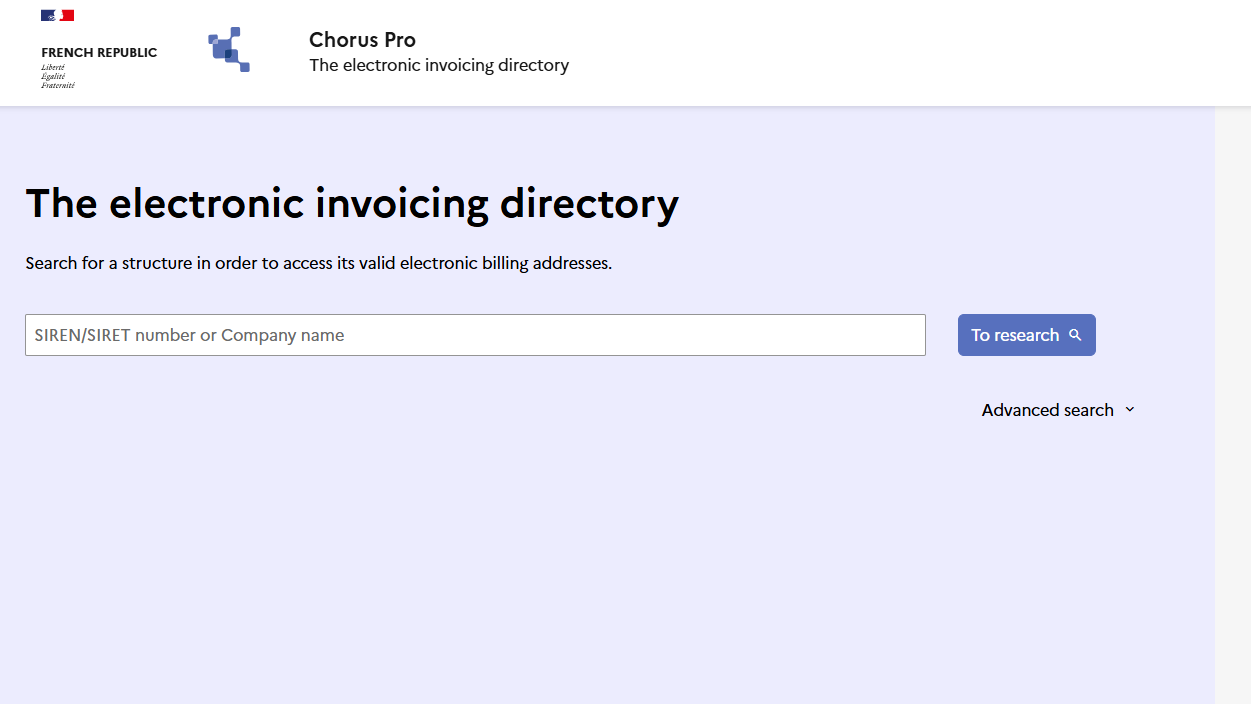
The central registry, called the Annuaire, helps with routing using the information regarding the recipient's declared platform and invoicing address.
2) Issue invoices in a supported structured format
To be interoperable, invoices must be structured in a format supported by your platform and compatible with the ecosystem’s minimum common formats.
3) Add new mandatory invoice data and keep master data clean
The fastest way to reduce rejections is to standardise invoice data and ensure identifiers match what is registered in the directory.
Mandatory element to manage
- Customer SIREN number
- Delivery address (when different from billing)
- Transaction type (goods, services, or both)
- VAT on debits indicator (when the supplier opted in)
- Supplier ID and buyer ID (including SIRET where applicable)
- Invoice number, issue date, and totals
4) Secure, preserve, and archive invoices
Two separate obligations apply at the same time. Tax law requires a minimum of 6 years. The Code de commerce requires 10 years from the close of the financial year. Retaining for 10 years satisfies both. Throughout that period, e-invoices must stay in their original electronic format. Converting or reprinting the file breaks the chain of authenticity the rules are designed to protect.
PPF and PA in France’s e-Invoicing Architecture
The French B2B e-invoicing system architecture is based on a two-tier approach, separating the state from private activities regarding invoice exchanges.
- PPF (Portail Public de Facturation): PPF is the public invoicing portal operated by the state. The state is responsible for maintaining the Annuaire for the identification of recipients, performing centralised supervision, and transmitting information on e-reporting and payments to the appropriate parties.
- PA (Plateforme Agréée):A PA, formerly known as a PDP (Plateforme de Dématérialisation Partenaire), is an officially approved private system for issuing, receiving, validating, and forwarding structured electronic invoices.
The PPF was originally designed to include a free invoicing option for businesses. That plan was dropped in late 2024. The PPF no longer handles invoice exchange between businesses. Its role is now limited to running the Annuaire (the central directory used to route invoices) and collecting fiscal data from approved platforms to pass on to DGFiP. Every business needs a PA to send or receive invoices.
Step-by-Step Process: How B2B e-Invoicing Works in France
This flow shows the process from invoice creation through delivery, reporting, and archiving in preparation for an audit.
Step 1: Classify the transaction
Each transaction will be classified by customer type, geographical location, and VAT requirements, and then sent via e-invoice (domestic B2B) or the e-reporting process (outside domestic B2B).
Step 2: Create a structured invoice in your ERP or billing system
The structured invoice is to be drafted in the supported structured format, ensuring the mandatory legal and VAT fields are filled. This will include the new mandatory particulars.
Step 3: Validate the invoice before submission
Check that all mandatory fields have been provided, do mathematical calculations, verify VAT calculations, and validate all required identification numbers, such as the customer’s SIREN or SIRET number and delivery address rules.
Step 4: Submit the invoice to your approved platform
Submit your invoice to the platform, which will validate it and prepare it for delivery to the receiver's platform.
Step 5: Route using the Annuaire
The platform queries the Annuaire for the recipient’s authorised platform information and invoicing address, then sends the invoice to that address.
Step 6: Receive acknowledgements and life-cycle statuses
The platforms send standardised acknowledgements and lifecycle status messages, allowing each party to see what is happening with the invoice throughout its lifecycle.
Step 7: Buyer processing and dispute handling
If the buyer does not accept the invoice or refuses to pay, follow an exception-handling procedure, such as correcting errors and issuing corrected invoices or credit notes.
Step 8: Transmit e-reporting and payment data when required
For sales outside domestic B2B, the platform transmits the required transaction data to the administration. For services where VAT is due on payment, it also transmits payment information on the required schedule.
Step 9: Archive and retain audit evidence
All structured invoices, when used, should be stored in an auditable archive in addition to their human-readable form.
Routing and Data Flow in France’s e-Invoicing Ecosystem
Proper routing ensures that each invoice is sent to its buyer, as registered in the business's PA in the Annuaire. Failure in routing might result in the rejection of invoices, failure to deliver them, and failure to report required tax information. Such routing enables companies to use other providers while still maintaining interoperability.
The table below explains, in simple terms, how invoices and reporting data move in each scenario.
Business situation | How the invoice is exchanged | What is sent to the tax authority |
Sender and buyer use the same PA (approved platform) | A single PA handles invoice submission, delivery to the buyer, and status updates | The PA automatically transmits the required invoice data to the tax authority as part of the process. |
Sender and buyer use different PAs | The sender’s PA identifies the buyer’s PA via the Annuaire and routes the invoice to it | Invoice data and any required reporting data are transmitted through the respective PAs to the tax authority. |
Transaction is outside domestic B2B scope, such as B2C or many cross-border sales | No e-invoice is exchanged between parties | Only transaction data, and payment data when required, is reported to the tax authority via the PA. |
How to Prepare for France’s e-Invoicing Rollout
Use this checklist to turn the mandate into an operational process that does not break at go-live.
Readiness and implementation checklist
These actions reduce integration delays and rejection rates:
- Assign an owner for e-invoicing, with clear AR, AP, IT, and tax responsibilities.
- Choose your receiving setup early, since all businesses must be able to receive from 1 September 2026.
- Master data cleaning: validate SIREN/SIRET numbers, VAT numbers, customer and supplier addresses, and payment terms.
- Classify transactions by e-invoicing or e-reporting categories, including transactions liable to VAT for payment.
- Upgrade ERP, billing, and AP tools to produce and ingest structured formats, and to process status messages.
- Route test via the Annuaire, perform end-to-end testing with important customers and suppliers.
- Exception procedures for invoice rejection/refusal and the credit note process need to be established.
- Archive, auditing, logging, and dashboard must be in place prior to the first mandatory transmission.
Public Portal vs PA
It is important to determine the operating approach based on invoice volume, integration needs, and process maturity.
Note: Following the DGFiP's announcement on 15 October 2024, and as legally codified in the 2026 Finance Law (February 2026), the PPF no longer handles B2B invoice exchange between businesses. The PPF retains its role as the central directory (annuaire) of registered entities and continues to support reporting and status functions.
Decision Factor | Low-Volume PA Access (manual/portal-based) | Mid-Tier PA Integration (semi-automated) | Full PA/ERP Integration (automated) |
Invoice volume | Best suited for very low volume (occasional or irregular invoices). | Suited for moderate, recurring invoice volumes. | Best suited for high-volume, continuous invoice flows. |
ERP integration | No ERP connector needed; invoices entered manually via the PA's web interface. | Partial integration; batch uploads or API calls with some manual intervention. | Full API or EDI integration with ERP/AP/AR systems; end-to-end automation. |
Format handling | The PA's web interface accepts your manual input and generates the compliant structured invoice format (Factur-X, UBL, or CII) on your behalf | PA handles format conversion with field mapping and output schema selection required during onboarding. | ERP outputs structured formats natively; PA validates and routes automatically. |
Operational monitoring | Manual checks on PA portal for status updates and rejections. | Semi-automated alerts; some manual exception handling required. | Fully automated routing, rejection alerts, status tracking, and exception workflows. |
Compliance scalability | Workable for micro-enterprises or TPEs with few transactions. | Suitable for SMEs scaling toward higher volumes. | Scales for multi-entity, multi-jurisdiction, and high-complexity environments. |
Typical fit | Micro-enterprises (TPE), occasional B2B sellers. | SMEs (PME) with moderate transaction volumes. | Large enterprises (GE), ETIs, and companies with cross-border obligations. |
Selecting the right PA
When implementing e-invoicing compliance, it's crucial that you work with the right platform. Here are some features that you may consider:
- Volume and automation capabilities: Integration via API, batch processing, and automated validation.
- ERP and Workflow integration capabilities: Integration connectors for ERP/Accounts Payable/Receivable systems, and status messages handling.
- Supported invoice formats: Inbuilt support for all the supported structures that you can issue/receive.
- Exception handling: Reasons for rejections, dispute management, and monitoring.
- Multi-platform capabilities: Using separate platforms for issuing/receiving invoices.
How to avoid failures and rejections
This table shows the most common issues that block delivery and how to prevent them.
Common failure point | How to prevent it |
Recipient not found or wrong routing address | Keep customer identifiers and invoicing addresses validated against the Annuaire. |
Missing new mandatory particulars | Update invoice templates to capture customer SIREN, delivery address logic, and transaction category. |
VAT calculation or totals mismatch | Add automated arithmetic and VAT rule checks before sending. |
Format validation error | Use platform validation in pre-production and lock to a supported format profile. |
Unresolved rejected or refused statuses | Define a timed exception workflow and track resolution until closed. |
What Are the Penalties for Non-Compliance?
The 2026 Finance Law sets out the penalty structure, and it is worth reading carefully because the numbers changed from earlier drafts.
Miss an e-invoice issuance, and you face a fine of €50 per invoice, capped at €15,000 per calendar year. Miss an e-reporting transmission, and it is €500 per failed submission, also capped at €15,000 per year. Both penalties apply separately, so you can be fined on both fronts at once.
There is one practical relief: a first-time breach within any four-year period can be waived, provided the infraction is corrected either spontaneously or within 30 days of a first formal request from the DGFiP. That is not a guaranteed pass, but it does matter if something goes wrong early.
Note: On 7 May 2026, at the annual E-Invoicing Day, DGFiP Director General Amélie Verdier stated clearly that there will be "no automatic and blind sanctions" for businesses making genuine compliance efforts from 1 September 2026. Businesses will be contacted first and asked to demonstrate their implementation progress before any enforcement action is considered. Separately, DGFiP representatives at the same event indicated that businesses actively onboarding, testing, and progressing in good faith may receive practical enforcement forbearance through at least 1 January 2027, and potentially longer, depending on how the ecosystem matures in the initial rollout phase. This is an administrative position, not a legal safe harbour, and should not be treated as a substitute for timely compliance.
Businesses will be contacted first and asked to show what they are doing to comply. Only persistent non-compliance, or a complete failure to engage with the reform, will lead to sanctions.
That does not mean the obligation disappears. It means France is giving businesses a working period to get it right, not a window to ignore it. Getting rejected invoices and unpaid buyers is a more immediate problem for most businesses than the fines, anyway.
Benefits of e-Invoicing for Businesses
The advantages arise from treating e-invoicing not as a compliance modification but as a business process improvement.
- More efficient processing of invoices, reduced error rates in data entry, and enhanced straight-through posting.
- Visibility on disputes thanks to standardized status notifications and clear responsibility for exceptions.
- More trustworthy audit trails, which consist of logs of invoices creation, delivery, and acceptance.
- Increased cash flow efficiency resulting from a reduction in delivery failures and more timely payment processing.
- Foundation for further automation, including VAT compliance processes simplification.
Government Resources and Official Portals
Use these official references to validate scope, deadlines, directory lookups, and platform registration.
Resource | What it covers |
Service-Public: publication of the list of registered approved platforms | Official rollout timetable, scope highlights, new mandatory particulars, and links to the platform list and legal texts. |
Reform overview, calendar PDFs, and access to the official list of approved platforms. | |
Definitions of e-invoicing, e-reporting, and payment reporting. | |
Directory search to identify recipient routing details (platform and invoicing address). | |
DGFiP external specifications for B2B e-invoicing and e-reporting | Technical and standards references for platform exchanges and reporting services. |
How ClearTax Handles B2B e-Invoicing Compliance in France
The mandate in France poses quite a technical challenge. With its decentralised, Peppol-driven architecture, it is clear that companies cannot rely on a single government portal to handle everything. The invoice transmission, lifecycle status management, electronic report submission, and Annuaire routing all need to work together and operate smoothly. This is where the platform layer comes into play.
ClearTax is the accredited PA, as it utilises the Y architecture model that complies with the processes set by the French regulators. The invoices are first processed via ClearTax and then forwarded to the recipient platform, where they undergo validation, routing, and reporting processes simultaneously rather than sequentially.
What that looks like in practice:
ClearTax integrates with your ERP system via an AI-powered integration agent, which manages the mapping and transformation processes that can take several months. Connectivity has become easier without compromising accuracy, which is especially important when you have to follow strict, structured standards such as Factur-X, UBL, and CII that meet the requirements of the Annuaire.
Apart from integration, ClearTax handles the entire invoice process. Rejection alerts, status confirmations, and e-reporting transmission notifications are all handled by ClearTax.
The platform also serves as a future-proofing tool for after September 2026. France is just one example; organisations operating in jurisdictions such as Germany, Belgium, and others will have similar requirements. The ability to comply globally allows organisations to avoid developing compliance systems in each jurisdiction separately, while keeping IT costs reasonable.
Organisations planning to meet the requirements of B2B e-invoicing France 2026 must understand the risks of being late. Organisations could face financial penalties, be subject to audits, and even receive rejected invoices when the mandate is active. At ClearTax, we believe that the danger should be mitigated before it becomes a problem.
Conclusion
France’s B2B e-invoicing reform is less about replacing PDFs and more about making invoice data usable across finance, tax, and operations. Start with clean identifiers and transaction mappings, then choose a platform you can operate reliably, test early, and treat exceptions as a tracked workflow, not an afterthought.
Frequently Asked Questions
About the Author

Rajan Rauniyar
I’m a Senior Content Writer at ClearTax, specializing in e-invoicing, VAT, and Tax compliance. Over the years, I’ve researched and written everything from blog posts to whitepapers and product guides, helping ClearTax expand in Malaysia, KSA, UAE, Singapore, Belgium, France and beyond. My goal is to write the most comprehensive, understandable, readable, and accurate content on any topic that has ever existed on the internet. Read more



Your data security and privacy matter most to us.