
POPULAR ARTICLES
- E-Invoicing in Germany 2027: Obligations, Timeline, Format & Examples
- How to Receive E‑Invoices in Germany? Format, Process, Validation and Archiving
- E-Invoicing for Small Businesses in Germany: Creating, Receiving, Deadlines & Formats
- Germany E-Invoicing FAQs: Everything You Need to Know German e-Invoicing Mandate
- Mandatory Data Fields Required for an e-Invoice in Germany
- OZG-RE Portal: Features, Registration & Best Practices
- XRechnung e-Invoicing Format? How to Create, Examples, Specifications
- How to Create e-Invoice in Germany: XRechnung & ZUGFeRD Format
- What is EN 16931? Electronic Invoicing Standard in Germany
- What is a Leitweg-ID (Buyer Reference Route ID)? Registration, Structure & Examples
- ZUGFeRD or XRechnung: Which Format Should You Use in Germany?
- How to Validate E-Invoices in Germany: Step-by-step Guide
E-Invoicing in Germany 2027: Requirement, Timeline, Format & Examples


Germany's B2B e-invoicing mandate is rolling out in phases under the Growth Opportunities Act. As per the latest BMF circular, businesses must be able to receive structured e-invoices from January 2025. From January 2027, businesses above €800,000 turnover must issue them for domestic B2B transactions; by January 2028, this applies to all businesses. Beyond compliance, the shift standardises invoice formats, reduces manual AP/AR work, and marks Germany's first step toward ViDA alignment by 2030.
Key Takeaways
- From January 2027, German businesses with turnover exceeding €800,000 must issue structured e-invoices for all domestic B2B transactions.
- E-Invoices must use EN 16931-compliant structured formats like XRechnung or ZUGFeRD 2.1+.
- From January 2025, All businesses must be able to receive and validate structured e-invoices.
- Businesses required to comply include all domestic B2B suppliers, VAT-taxable entities, B2G suppliers, and foreign companies with a fixed establishment in Germany.
- E-Invoices must be archived in their original structured format for at least 8 years to ensure audit readiness.
- Exemptions apply to B2C transactions, small businesses under §19 UStG (annual turnover up to €22,000), invoices under €250, passenger tickets, and VAT-exempt sales, and inter EU transactions.
What is e-Invoicing in Germany?
An e-invoice is an invoice issued, sent, and received in a structured electronic format that computers can read and process automatically. Unlike a PDF or paper invoice, it eliminates manual data entry, enabling faster, error-free exchange between accounting systems.
E-invoicing in Germany is exchanging invoices in a structured electronic format compliant with the EN 16931 standard, such as XRechnung or ZUGFeRD, not a normal or scanned PDF emailed to a customer. It applies to all inland B2B & B2G transactions and is transmitted through channels such as Peppol, service provider platforms, EDI, or email rather than paper, enabling automated validation and posting in accounting systems. Businesses must also archive e-invoices for 8 years to remain compliant.
Germany's B2B e-invoicing mandate is introduced through the Growth Opportunities Act (Wachstumschancengesetz) and implemented via amendments to Section 14 of the German VAT Act (UStG). The BMF has since issued circulars and amendments, including the 15 Oct 2025 circular, to help businesses navigate compliance.
Germany E-Invoicing Timeline and Compliance Deadlines
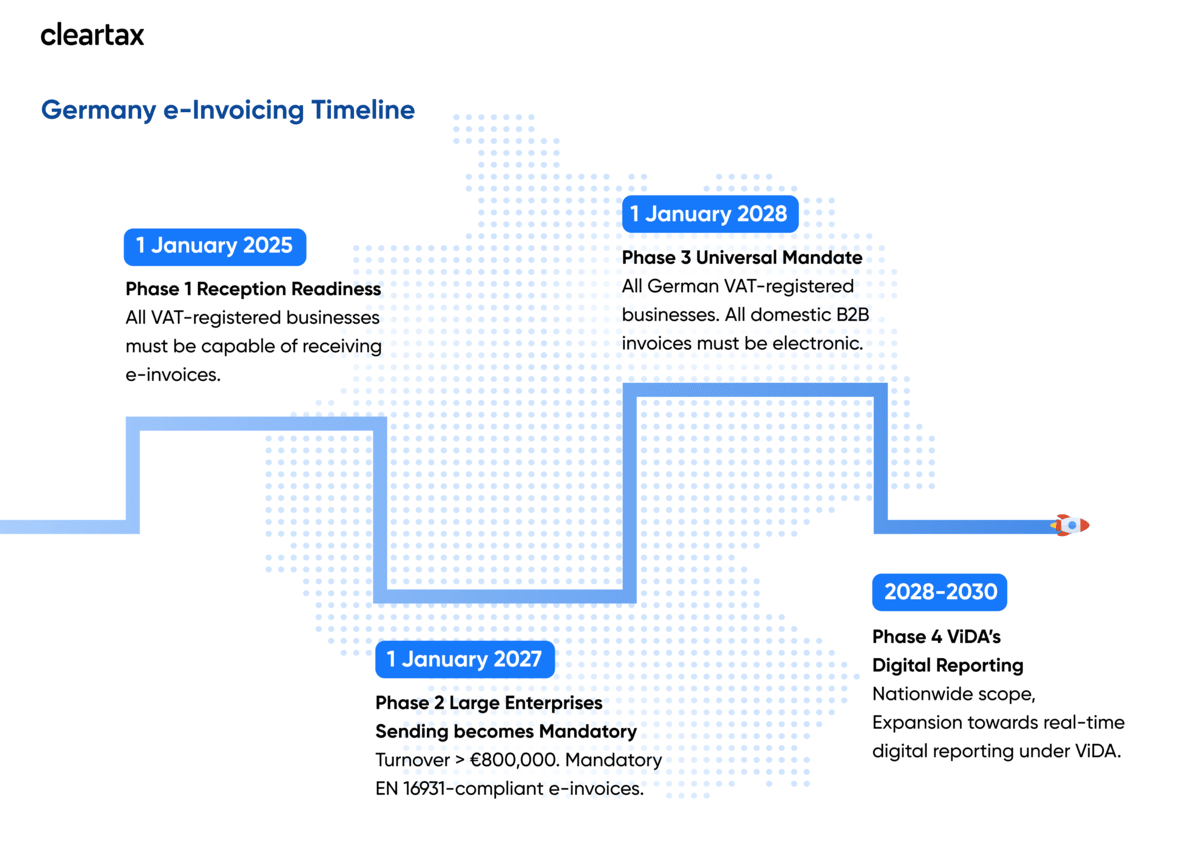
Germany's e-invoicing timeline is phased across three stages: receiving e-invoices became mandatory from 1 Jan 2025, large businesses (turnover above EUR 800,000) must issue them from 1 Jan 2027, and all businesses face the mandate from 1 Jan 2028.
How Does E-Invoicing Work in Germany?
E-Invoicing in Germany works through a structured process, from XRechnung or ZUGFeRD-compliant creation and transmission through Peppol or EDI, to receipt validation, 8-year archiving, and post-audit compliance as mentioned below:
- E-Invoice Creation (Erstellen): A business prepares the bill using ERP platforms, bookkeeping applications, or an electronic invoicing solution provider. It should also have all tax details correctly written as per VAT compliance. The document must comply with German standards such as XRechnung or ZUGFeRD.
- Transmission: The invoice is sent to trading partners via email, EDI, Peppol network, or service provider platforms. The channel may be chosen by agreement. But the invoice itself must stay structured.
- Receipt and Validation (Empfangen): The recipient’s software checks format and data integrity. Valid e-invoices are automatically processed into ERP or accounting systems.
- Processing & Archiving: The invoice must remain preserved in its native electronic form for 8 years. It should remain genuine, intact, readable, plus accessible for audit.
- Post-Audit Compliance: Tax authorities in Germany do not receive invoices in real time. They may request invoice data during an audit, but there is no pre-clearance or live reporting obligation for businesses.
- B2G E-Invoicing: For public authorities, documents are submitted through official state platforms such as E-Rechnungsportal Bund, OZG-RE, or regional government portals. E-invoicing solution providers can help businesses send the files correctly and connect to these portals automatically.
E-Invoicing Framework (Model) in Germany
Germany's e-invoicing framework follows the Peppol 4-corner model, enabling secure, structured, and interoperable electronic exchange, with enough flexibility to support the Digital Reporting Requirements (DRR) under ViDA when they come into effect.
- Decentralized Exchange (Peppol 4 Corner Model): It does not use a central clearance portal for B2B invoices. Unlike some countries, businesses in Germany do not need to send every B2B invoice to the government platform first before issuing it. Companies can send invoices directly using email, EDI, Peppol, ERP connections, or service provider networks.
- Public Sector (B2G) Portals: For B2G invoices, official portals are still used. Suppliers invoice public entities through platforms such as E-Rechnungsportal Bund, OZG-RE, or state-specific portals. These portals are Peppol-enabled and accept XRechnung plus compatible ZUGFeRD files.
- Post-Audit Model: Germany uses a post-audit model for e-invoicing. This means tax authorities may request invoices for audit after the fact but do not automatically receive all invoices in real time.
E-Invoicing Format in Germany
EN 16931-compliant formats like XRechnung and ZUGFeRD are the officially accepted electronic invoice formats in Germany. Both formats defines the mandatory data structure and content required for electronic invoices in Germany.
- XRechnung (XML): Germany’s official EN 16931 implementation, used widely for B2G and accepted for B2B. It’s designed for system-to-system processing, so finance teams typically view it through ERP/accounting tools rather than “reading” the file directly.
- ZUGFeRD (Hybrid PDF/A-3 + Embedded XML): A practical hybrid for finance teams: a readable PDF plus structured XML for automation. For compliance, only the EN 16931-aligned profiles (2.0.1+ / COMFORT or EXTENDED) should be treated as mandate-ready, and the XML is the legally relevant part.
- EDIFACT / Legacy EDI: Legacy EDI setups can continue during the transition where already established and agreed by both parties. But long term, especially from 2028, the EDI process must be able to produce or extract EN 16931-compliant structured data.
- Peppol BIS Billing 3.0 (UBL): A standardized way to exchange structured invoices via the Peppol network. It’s a strong option when you need interoperability across many trading partners, provided the content remains correctly mapped to EN 16931.
- XML (General): “XML” alone is not a compliance indicator. A random XML file is not automatically compliant. It must follow an accepted EN 16931 implementation, such as XRechnung XML, ZUGFeRD embedded XML, or properly mapped UBL.
Who must comply with Germany's e-Invoicing mandate?
The mandate mainly applies to domestic B2B transactions where both businesses are in Germany:
- All domestic B2B Businesses: For transactions where both the supplier and the recipient are based in Germany.
- Businesses Providing Taxable Supplies under VAT: Any taxable supply of goods or services that fall within the scope of German VAT law (UStG).
- Business-to-Government (B2G) suppliers: Business invoicing to federal and state public administrations.
- Foreign Entities with Local Establishments: Foreign businesses operating in Germany with "fixed establishment" (e.g., a physical office or warehouse
Who is exempt from e-invoicing in Germany
The following transactions and entities are exempt from Germany's e-invoicing mandate:
- Small-amount invoices with a gross total of €250 or less.
- Passenger transport tickets, which are exempt from structured invoice requirements.
- VAT-exempt transactions as defined by specific provisions in the VAT Act (UStG)
- Foreign businesses without Local establishment: Businesses that are only VAT-registered in Germany, but do not have a fixed establishment in Germany, are not subject to this mandate and may indicate this on the invoice to explain why they are not issuing an e-invoice.
- Cross-border transactions whether incoming or outgoing.
- Business-to-consumer (B2C) transactions: Sales to private individuals remain outside the scope. Traditional formats such as paper receipts or PDFs can still be used for consumer sales.
What are the Mandatory Data Fields for E-Invoicing in Germany?
Based on EN 16931 standards, the mandatory data fields required for e-Invoicing in Germany are as mentioned below:
- Seller (Supplier) Name and Address
- Buyer (Recipient) Name and Address
- Seller Tax Identification
- Consecutive Invoice Number
- Invoice Issue Date
- Date of Supply or Service Performance
- Description of Goods or Services
- Quantity and Unit of Measurement
- Applicable VAT Rate
- Net Amount per Line (Excluding VAT)
- VAT Amount
- Total Invoice Amount (Including VAT)
- Currency
- Authenticity of Origin
- Integrity of Content
- Readability
E-Invoice Archiving and Retention under GoBD Standards in Germany
Germany requires e-invoices to be archived under GoBD rules in their original electronic format.
- Keep the Original File: XML must remain XML. ZUGFeRD must remain the hybrid file (PDF/A-3 with embedded XML).
- Maintain Integrity and Authenticity: No silent edits. Any corrections must be traceable and logged.
- Apply the Hybrid Invoice Rule: If the PDF and XML differ, the XML is the legally relevant record. The PDF is only a visual rendering.
- Ensure Audit Readiness: Invoices must remain readable, searchable, and exportable during audits.
- Retention period: Invoice retention in Germany is generally 8 years . However, invoices may need to be kept longer if they remain relevant for taxes for which the assessment period is still open; the BMF expressly mentions section 15a UStG real-estate input-tax adjustment cases.
Retention is generally 8 years, but certain cases still require 10 years depending on tax obligations.
E-Invoicing Penalties in Germany
- Administrative Fines: Under §26a UStG, fines range up to €5,000 (general offences), €1,000 (retention violations), and €30,000 (serious cases under subsection 1).
- VAT Deduction Risk: Non-compliant invoices can be rejected, blocking input VAT claims until corrected.
- Reissuance Obligation: Invoices failing format/data standards must be corrected and reissued before use.
- Record-Keeping Breaches: Failing to archive e-invoices in structured, readable, auditable form for the retention period is a separate violation.
What Must Businesses Do in 2026?
Here is how German Businesses can be compliant with e-Invoicing obligations:
- Map Current Invoice Flows: Track how invoices are generated, approved, sent, collected, and archived. Also identify places where excessive human effort or repetitive handling still exists.
- Understand Compliance Requirements: Check which invoice documents must shift into e-invoices, which structures are accepted such as XRechnung or ZUGFeRD, along with the applicable implementation timelines.
- Upgrade IT Infrastructure: ERP platforms or bookkeeping applications must handle valid e-invoice structures properly. Some businesses may need extra tools or better software.
- Select the Right E-Invoicing Provider: Assess capabilities, legal compliance scope, connectivity methods, together with customer assistance across different service vendors. Look for certified Peppol access and automatic format validation.
- Establish Internal Policies: Prepare formal workflows for transmitting, accepting, plus archiving e-invoices. Assign duties, accountability, besides escalation procedures for invoice discrepancies or failures.
- Train Employees and Communicate Externally: Accounting, IT, and operations teams should get proper training. Companies should also notify buyers and vendors regarding their e-invoicing arrangement.
- Test Thoroughly Before Going Live: Run pilot e-invoicing programs with chosen vendors and buyers. This helps check if invoices move properly without errors.
- Monitor Regulatory Changes: E-invoicing obligations may evolve gradually. Organizations should frequently monitor official notices plus vendor communications to remain compliant.
How ClearTax Simplifies Germany's E-Invoicing Compliance?
ClearTax helps you go live with Germany-compliant e-invoicing faster, with fewer manual touchpoints. ClearTax is a VeR recognised provider for businesses navigating the current mandate and preparing ahead for E-Reporting (2028) and ViDA's Digital Reporting Requirements (DRR).
- ERP-Compatible Integrations: Connects with SAP, Oracle, Dynamics, alongside additional systems for automated mapping, validation, together with compliant generation.
- Unified Dashboard: Generate, deliver, monitor, plus archive electronic invoices across numerous structures securely through one dashboard.
- Peppol Connectivity: Supports compliant transmission across Germany and EU public-sector processes.
- Continuous Compliance: Built-in validation, regulatory updates, together with secure long-term archiving.
- Scalable Infrastructure: Multi-entity functionality, strong security controls, plus guided onboarding.
Frequently Asked Questions
About the Author

Rajan Rauniyar

I’m a Senior Content Writer at ClearTax, specializing in e-invoicing, VAT, and Tax compliance. Over the years, I’ve researched and written everything from blog posts to whitepapers and product guides, helping ClearTax expand in Malaysia, KSA, UAE, Singapore, Belgium, France and beyond. My goal is to write the most comprehensive, understandable, readable, and accurate content on any topic that has ever existed on the internet. Read more


Cleartax is a product by Defmacro Software Pvt. Ltd.

Your data security and privacy matter most to us.