
POPULAR ARTICLES
- Top E-Invoicing Service Providers in UAE: FTA Approved List
- UAE e-Invoicing Frequently Asked Questions (FAQs)
- How to Choose Your UAE E-Invoicing Technology Partner
- SAP UAE E-Invoicing Integration for SAP S/4HANA, ECC & SAP Business One
- List of ERP Changes Required for UAE E-Invoicing Compliance
- AP e-Invoicing in UAE: How Buyers Receive and Process E-Invoices?
- API, Middleware & ERP Integration for UAE E-Invoicing
RELATED ARTICLES
- e-Invoicing in UAE: Key Requirements, Implementation Timeline & Latest Updates
- What is the Peppol CTC Model in UAE for E-Invoicing?
- UAE e-Invoicing Frequently Asked Questions (FAQs)
- UAE Tax Credit Note: Examples, Formats & Benefits
- Digital Signature Certificate in UAE: Benefits, Process & How It Works
- VAT Invoice in UAE: Mandatory Details & Format
- VAT Rate List in UAE
- How to Claim VAT Refund in UAE?
- What are the Penalties for Non-Compliance under the UAE VAT?
- TRN Verification in UAE: Step-by-Step Process to Verify VAT Number in UAE
- Excise Registration in UAE: A Comprehensive Guide
YOU MIGHT BE INTERESTED IN
UAE E-Invoicing Use Cases: 16 Scenarios & FAQs Businesses Must Know


The UAE e-invoicing mandate rolled out on a voluntary basis from 1st July 2026 and will become compulsory for businesses from January 2027 in a phased manner. E-invoicing will reduce the time spent on manually processing data. It applies to any person conducting business in the UAE, regardless of VAT registration status, and covers B2B and B2G transactions unless a specific exclusion applies.
In this article, we decode UAE e-invoicing’s 16 use cases that define different invoice scenarios for businesses under the country's upcoming e-invoicing framework. They cover everything from standard tax invoices and exports to self-billing, reverse charge transactions, and summary invoices. Understanding these use cases will help businesses assess whether their ERP and invoicing processes are ready for the new e-invoicing requirements.
Key Takeaways
- The UAE government has identified sixteen e-invoicing use cases, of which five are mandatory use cases, and eleven are conditional or edge cases.
- The PINT AE data dictionary specifies the data fields required for each use case, while the UAE e-invoicing consultation document outlines the proposed invoice types and framework.
- Not every business needs every use case. They only need to support those that match their business transactions.
- Reviewing your invoicing processes now will make it easier to prepare for the UAE e-invoicing July 2026 rollout and future implementation phases.
What are the UAE E-Invoicing Use Cases?
In the context of UAE e-invoicing, a use case is a business scenario that requires a specific type of invoice.
Not every business issues invoices in the same manner. For instance, a retailer may issue a standard tax invoice, while an exporter may issue an invoice for zero-rated supplies. On the other hand, some businesses may receive self-billed invoices from their customers.
Instead of creating different invoice formats for different businesses, the UAE has standardised these scenarios into 16 recognised use cases. Each use case defines:
- The invoice type
- The mandatory data fields
- When it applies
- Any additional information required
The e-invoicing framework follows the PEPPOL 5-corner model UAE, allowing invoices to be exchanged electronically between businesses through accredited service providers.
16 UAE E-Invoicing Use Cases
The Ministry of Finance in the UAE has published a public consultation document, highlighting the 16 major use cases for e-invoicing. Of these, five are mandatory, while the remaining 11 apply only to specific business scenarios.
| Type of Invoice | Category | Use Case (When it Applies) |
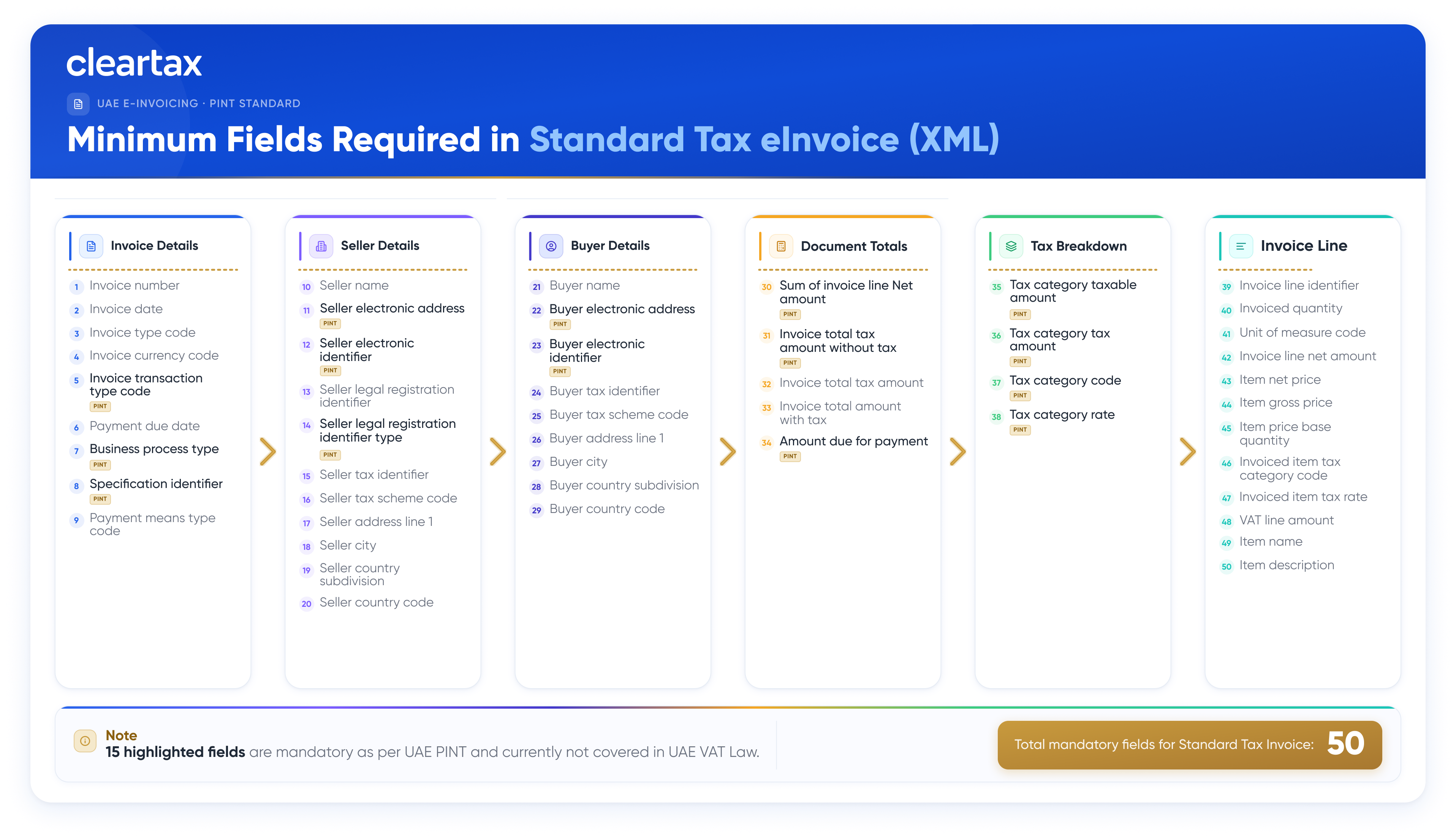
| Standard Tax Invoice | Mandatory | Used for standard taxable B2B supplies. The invoice contains 50 mandatory fields, including 15 fields not currently covered under UAE VAT law. |
| Standard Tax Credit Note | Mandatory | Used to reduce or cancel all or part of a previously issued standard tax invoice. |
| Commercial Invoice | Mandatory | Used for goods exported outside the UAE where a commercial invoice is required. The invoice contains 49 mandatory fields, some of which are not currently captured under existing UAE VAT invoicing rules. |
| Self-billing Invoice | Mandatory | Used when a customer issues the invoice on behalf of the supplier under a self-billing agreement. |
| Self-billing Tax Credit Note | Mandatory | Used when a customer issues a credit note on behalf of the supplier under a self-billing arrangement. |
| Supply Under Reverse Charge Mechanism | Additional (Conditional) | Used for supplies where the recipient accounts for VAT under the reverse charge mechanism. |
| Zero-rated Supplies | Additional (Conditional) | Used for supplies subject to 0% VAT, such as qualifying exports or international transport. The invoice requires additional information, including the applicable zero-rating reason and exemption reason codes, where relevant. |
| Deemed Supply | Additional (Conditional) | Used where the VAT law treats a transaction as a taxable supply even though no consideration is received. |
| Margin Scheme | Additional (Conditional) | Used for supplies that fall under the UAE VAT margin scheme, such as eligible second-hand goods. |
| Summary Tax Invoice | Additional (Conditional) | Used when multiple taxable supplies are made to the same customer during a specified period (The transactions can be consolidated into a single invoice, where permitted.) |
| Continuous Supplies | Additional (Conditional) | Used for supplies provided on a continuous or recurring basis, such as utilities or maintenance contracts. |
| Supply Involving Free Trade Zone | Additional (Conditional) | Used for transactions involving a designated free trade zone. |
| Supply Through E-Commerce | Additional (Conditional) | Used for supplies made through electronic commerce platforms. |
| Exports | Additional (Conditional) | Used for export transactions requiring export-specific invoice information. |
| Disclosed Agent Billing | Additional (Conditional) | Used when an agent issues the invoice on behalf of a disclosed principal. |
| Disclosed Agent Billing Tax Credit Note | Additional (Conditional) | Used when a credit note is issued by a disclosed agent on behalf of the principal. |
Why Do the 16 Use Cases Matter for Businesses?
The 16 use cases are more than just different invoice types under the UAE’s e-invoicing laws. They determine exactly how invoices must be generated, and all the relevant information relating to a particular transaction. If a business uses the wrong invoice type or misses any of the mandatory fields, the invoice may fail validation and get rejected.
The use cases also help businesses to:
- Identify which invoice scenarios apply to their operations
- Configure their ERP and billing systems correctly
- Capture the right data relevant to a particular type of transaction
- Reduce errors and corrections once e-invoicing becomes mandatory
For many organisations, understanding these use cases helps identify the few that are relevant to their business, and ensures that their invoicing system can handle them correctly.
What Data Fields Are Required Across These Use Cases?
The UAE e-invoicing framework is built on the PINT AE data dictionary, which details the information that must be exchanged for each invoice scenario.
A standard tax invoice has 50 mandatory fields under the UAE e-invoicing framework, along with a set of conditional fields that apply only to specific use cases. The exact number of fields on any given invoice therefore depends on the transaction type.
Most invoices include information across the following categories:
| Data Category | Examples |
| Seller details | Supplier name, TRN, address |
| Buyer details | Customer name, TRN (where applicable), address |
| Invoice details | Invoice number, invoice type, issue date |
| Tax breakdown | VAT category, VAT rate, taxable amount, tax amount |
| Line item details | Description, quantity, unit price, line amount |
| Payment information | Payment terms, due date, payment means (where applicable) |
| Document references | Purchase order, contract reference or previous invoice reference, if applicable |
| Additional scenario-specific information | Reverse charge details, export information, self-billing indicator, free trade zone details, e-commerce information, margin scheme information, etc. depending on the applicable use case |
The following image highlights the mandatory fields required on a standard tax e-invoice under UAE e-invoicing norms.
How Should Businesses Prepare for These Use Cases?
The UAE e-invoicing framework is being introduced in phases. However, businesses should begin reviewing their invoicing processes well before implementation for seamless invoice generation and exchange.
Some practical steps include:
- Identify the applicable use cases: Map your transactions against the 16 recognised use cases to determine which ones apply to your business.
- Review your ERP and billing systems: Check whether your existing system can capture additional information in scenarios like exports, reverse charge, free trade zones, or self-billing.
- Assess your invoice data: Make sure that customer, supplier, and tax information is fully and consistently captured before implementing structured e-invoicing.
- Understand the PINT AE data dictionary: Review the mandatory and conditional fields that apply to your invoice types from the PINT AE data dictionary.
- Work with an accredited service provider: Since the UAE uses the PEPPOL 5-corner approach, companies will send invoices through their access points instead of directly to one another.
- Plan system testing early: Testing invoice generation, validation, and exchange before go-live can help identify data gaps and integration issues.
Conclusion
UAE's e-invoicing framework goes beyond just replacing paper invoices with digital ones. It introduces a standardised way of invoice creation and exchange, to facilitate the machine processing of invoices.
Although there are 16 UAE e-invoicing use cases, companies will require the support of only those use cases that apply to their business. This begins with identifying the relevant use cases and ensuring that the ERP or invoicing software system can produce valid e-invoices that include the specified data fields.
With the phased rollout expected to begin from July 2026, businesses that start preparing early will be better placed to achieve compliance with minimal disruption.
Frequently Asked Questions
About the Author

Tanya Gupta

A Chartered Accountant by profession and a content writer by passion, I've dedicated my career to unraveling the complexities of GST. With a firm belief that learning is a lifelong journey, I've honed my skills in simplifying intricate legal jargon into easily understandable content. The satisfaction of transforming complex tax laws into relatable narratives is what drives me. Read more


Cleartax is a product by Defmacro Software Pvt. Ltd.

Your data security and privacy matter most to us.