
Oman's PEPPOL 5 Corner Model: How it Works under Fawtara E-Invoicing?
Updated on: Aug 4th, 2026
|
18 min read


Phase one of Oman’s Fawtara e-invoicing system is all set to launch in August 2026. Under this system, businesses do not exchange invoices directly with their buyers. Instead, the system follows the PEPPOL 5 corner model, where invoices pass through accredited intermediaries before reaching the Oman Tax Authority for validation, and thereafter they are delivered to the buyer. This standardised model allows businesses to exchange invoices securely, while following the country’s technical and regulatory requirements.
Key Takeaways
- The PEPPOL 5 corner model adds the Oman Tax Authority as a participant to the traditional four-corner PEPPOL network.
- The PEPPOL 5 corner model Oman follows the PEPPOL International (PINT OM) invoice specification and uses the PEPPOL network for invoice exchange.
- Under the Oman 5 corner model, every e-invoice is validated by the supplier's Access Point before transmission, and invoice data is simultaneously reported to the Oman Tax Authority in near real-time.
- Businesses connect to the network through accredited PEPPOL access points instead of exchanging invoices directly with their trading partners.
- Choosing a reputable service provider for e-invoicing requirements in Oman ensures simpler compliance, integration, and future regulatory updates.
What is the PEPPOL 5 Corner Model in Oman?
Oman's Fawtara e-invoicing system uses the PEPPOL network for invoice exchange. However, it introduces one important change. Instead of the traditional four participants, it includes the Oman Tax Authority as a fifth participant in the invoice exchange process. This is why it is called the PEPPOL 5 corner model.
The additional participant enables continuous transaction controls (CTC). Before an invoice reaches the buyer, it is first submitted to the Oman Tax Authority for validation. Once approved, the invoice continues through the PEPPOL network and is delivered to the recipient.
This approach gives the Tax Authority near real-time visibility into the transaction details while allowing businesses to continue exchanging invoices through a globally-recognised secure framework.
To understand exactly how the PEPPOL 5 corner model works, it is helpful to look at each of the five participants involved in the invoice exchange process.
Corner 1: The Supplier
Corner 1 represents the supplier issuing the invoice. The supplier generates an electronic invoice through its ERP or accounting/billing software as per the prescribed format using the PINT OM specification. The supplier then sends the invoice to its chosen PEPPOL Access Point.
Corner 2: The Supplier's PEPPOL Access Point
The supplier’s Access Point acts as the secure gateway into the PEPPOL network. It performs several important checks before it forwards the invoice. This includes validation of the structure, confirming mandatory data fields, and verifying the recipient's PEPPOL ID, amongst others.
Once these checks are completed, the invoice is securely transmitted through the PEPPOL network.
Corner 3: The Buyer's PEPPOL Access Point
The buyer's PEPPOL Access Point receives the validated invoice through the PEPPOL network. The Access Point identifies the intended recipient and securely delivers the invoice to the buyer’s business system using PEPPOL messaging protocols. It also confirms successful transmission and manages communication between trading partners in the PEPPOL network.
Corner 4: The Buyer
The buyer refers to the recipient of the electronic invoice. Since the invoice has already been validated, the buyer receives a compliant e-invoice that is ready for processing within their ERP or finance system. This reduces manual data entry, minimises invoice disputes, and speeds up accounts payable processing.
Corner 5: The Oman Tax Authority
The Oman Tax Authority’s centralised Fawtara platform is the 5th corner. This is the additional participant to PEPPOL’s traditional four corner model. Once validated by the seller’s Access Point, the Tax Authority receives the prescribed invoice data in the form of Tax Data Document (TDD), simultaneously through the PEPPOL network. It then performs its own set of validations against Oman’s e-invoicing rules. This gives the Tax Authority near real-time visibility into invoice transactions without affecting the exchange between sellers and buyers.
How Does the PEPPOL 5 Corner Model Work in Oman?
To understand how the PEPPOL 5 corner model works under Oman’s e-invoicing framework, let’s follow the journey of a single invoice.
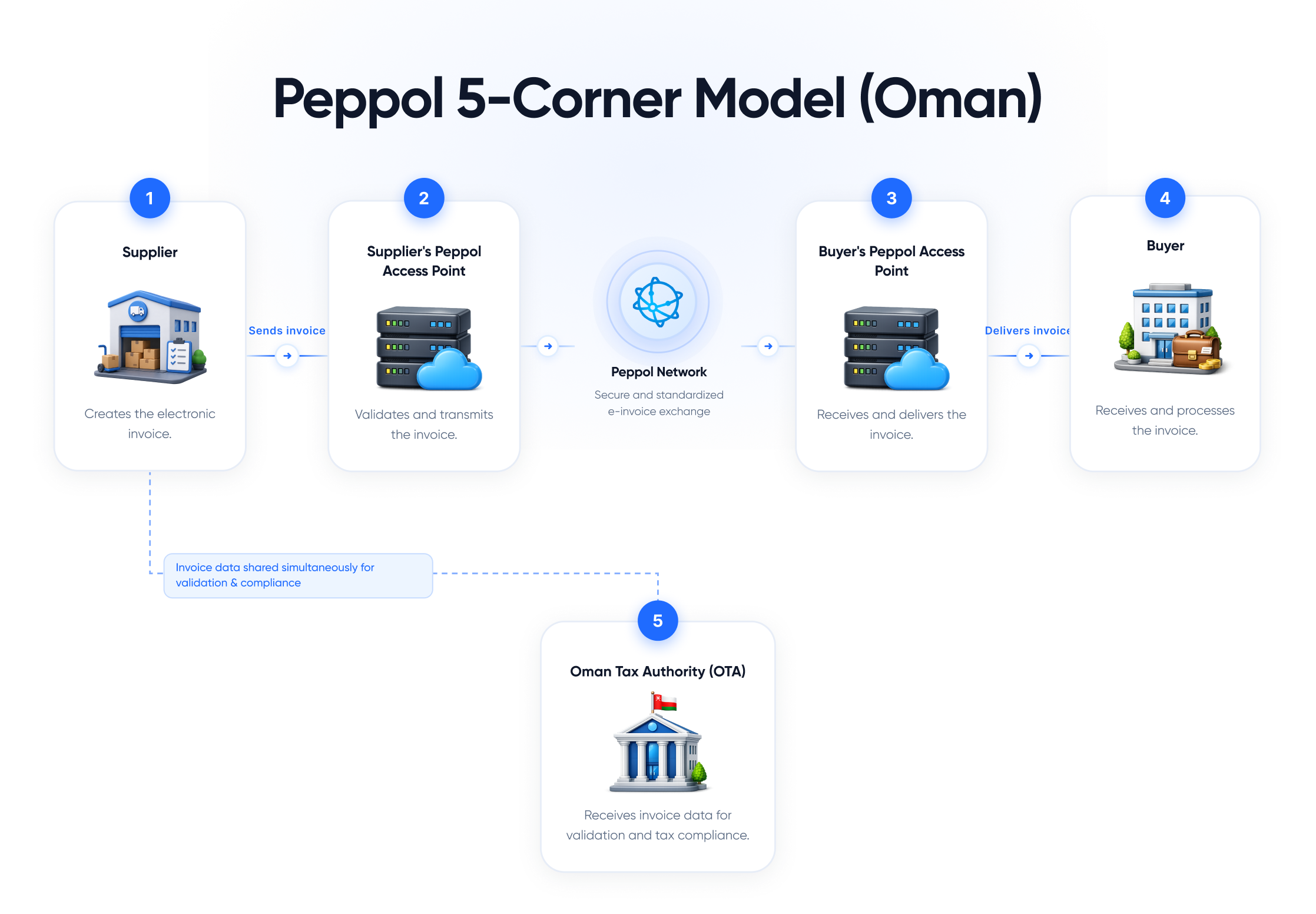
Step 1: The Supplier Creates the Invoice
The first step involves the supplier creating an invoice on their existing ERP or accounting/billing system. The invoice is generated in the PEPPOL International Oman (PINT OM) format instead of a PDF or paper invoice.
At this stage, the supplier must ensure that all mandatory fields are included. If any required information is missing, the invoice is likely to fail validations checks later on in the process and will risk getting rejected.
Step 2: The Invoice is Sent to the Supplier's PEPPOL Access Point
Next, the supplier submits the invoice to its accredited PEPPOL Access Point. The Access Point checks whether the invoice complies with the required technical specifications. It also verifies whether the buyer can receive documents through the PEPPOL network before it proceeds to forward the document.
Step 3: The Cleared Invoice is Transmitted to the Buyer's Access Point
Once validated by the Supplier’s access point, the invoice is routed to the buyer’s PEPPOL Access Point through the secure PEPPOL network. The buyer’s Access Point identifies the recipient and delivers the invoice to the buyer’s business system.
Step 4: The Buyer Receives the Invoice
The buyer receives a validated electronic invoice that can be processed directly within its ERP system. Since the invoice has already passed validation checks before being transmitted through the seller’s Access Point, manual verification is significantly reduced. Businesses can process invoices much faster and with fewer disputes.
Step 5: The Invoice Reaches the Oman Tax Authority
Once the seller’s Access Point has validated an invoice, the invoice is also shared with the Oman Tax Authority in near real-time. The Authority validates the invoice against Oman’s Fawtara e-invoicing rules, though the bulk of compliance checks has already been done at the seller’s end before transmission. Some validation checks done here include checking the invoice against the prescribed PINT OM specification, ensuring all mandatory data is available, and all applicable business rules are followed.
PINT OM Specification and Technical Standards
The success of the PEPPOL 5 corner model in Oman depends on every participant following the same technical standards. If businesses exchange invoices in different formats, the network will not be able to function. For this reason, Oman has adopted the PEPPOL International Invoice for Oman (PINT OM) specification for e-invoicing.
PINT OM is the standardised e-invoicing and tax reporting framework adopted by the Oman Tax Authority. It customises the global PEPPOL PINT standard to meet Omani VAT requirement as well as to meet the technical requirement of Oman's Fawtara e-invoicing framework.
Some of these technical requirements include:
- E-invoices must only be issued in XML (UBL 2.1) or PDF/A-3 format aligned with the PINT OM specification.
- The invoice must contain all the mandatory data fields, as listed by the Oman Tax Authority.
- Businesses must integrate with an accredited PEPPOL Service Provider and exchange invoices only through the accredited PEPPOL Access Points.
- Every participant must use a valid PEPPOL electronic address (PEPPOL ID) to send and receive invoices.
- Invoices need to be validated before they are delivered to the buyer and reported to the Oman Tax Authority.
As the Fawtara framework evolves, businesses need to make sure that their systems remain updated whenever new versions of the PINT OM specification are released.
What are PEPPOL Access Points?
A PEPPOL Access Point is a certified service provider that connects a business with the PEPPOL network. Instead of building a direct connection with each supplier and customer separately, a business can connect just once with its selected Access Point. The Access Point then handles secure communication with every other participant in the network.
For better understanding, think of it as an internet service provider for electronic invoicing. You connect only once, but you can communicate with thousands of businesses without the need to set up individual integrations.
In Oman, Access Points play an even bigger role because, besides the buyer and seller, they facilitate communication with the Oman Tax Authority as part of the PEPPOL 5 corner model.
A PEPPOL Access Point typically performs functions such as:
- Converting invoice data into the required PINT OM format
- Validating the invoice structure before transmission
- Securely transmitting invoices through the PEPPOL network
- Receiving incoming invoices from suppliers
- Managing acknowledgements and message status
- Supporting future updates to PEPPOL and Oman-specific technical requirements
How to Choose a Provider with the PEPPOL 5 Corner Model in Oman?
Selecting the right provider for e-invoicing in Oman becomes as important as choosing the right ERP. Your Access Point becomes the bridge between your business, your trading partners, and the Oman Tax Authority (OTA).
Here are the key factors you must evaluate before you make a decision.
1. Proven Implementation Experience
This may seem obvious, but oftentimes, businesses prefer to go with the more cost-effective alternative over a more experienced service provider. Experience matters. Hence, providers that have already implemented e-invoicing in multiple regions/countries have more mature products, a stronger understanding of regulatory changes, and better post-implementation support.
2. Supports the Complete PINT OM Specification
The provider you choose must be able to fully support the latest PINT OM requirements as per Oman’s Fawtara e-invoicing system. Further, the provider’s platform must have automatic updates whenever new technical specifications are introduced.
3. Has an Accredited PEPPOL Access Point
It is important to always verify that the provider operates an accredited PEPPOL Access Point. Accreditation confirms that the provider meets PEPPOL’s technical and security requirements for electronic document exchange.
4. Offers Seamless ERP Integration
A good provider should be able to seamlessly integrate with your existing ERP or accounting software without requiring any major process changes. The use of standard APIs and ready connectors typically reduces implementation time.
5. Ensures Thorough Validation Checks Before Submission
Detecting errors in time before the invoice is transmitted prevents invoice rejections and saves both time and effort. Look for a provider that performs technical and business-rule validation before invoices are submitted.
6. Scalable for Future Mandates
If your enterprise is already operating across several countries or plans to expand in the near future, choose a provider that already supports global PEPPOL implementations. It also helps if the provider offers a unified platform for managing compliance across jurisdictions. This reduces operational complexities and compliance costs in the long run.
Benefits of the 5-Corner Model for Omani Businesses
Oman’s 5-corner model is designed to improve both tax compliance and overall efficiency in invoice exchange. While some businesses may initially view it as another compliance requirement, the model offers several long-term operational benefits.
- Better Invoice Accuracy: Invoices are validated before being shared with the buyer. Hence, errors due to an incorrect structure or missing information can be detected early, reducing rework later.
- Faster Invoice Processing: Structured data from the invoices gets entered into business systems automatically, thereby reducing manual effort. This enables the company’s finance teams to process invoices more quickly.
- Improved Tax Compliance: As every invoice needs to be validated by the Oman Tax Authority, businesses are more likely to remain compliant with Oman’s e-invoicing and VAT laws.
- Secure Document Exchange: Since the PEPPOL network uses standardised protocols and Access Points, the invoice exchange process becomes much more secure than email-based processes.
- Easier Connectivity with Trading Partners: Instead of creating separate integrations with each customer and supplier, a business connects only to one Access Point, simplifying connectivity with trading partners.
- Better Audit Readiness: Electronic invoices are exchanged in a structured format post stringent validation checks, with clear records of validation and transmission history, making audits easier to support.
How ClearTax Supports PEPPOL 5-Corner Compliance in Oman
ClearTax helps businesses prepare for Oman’s Fawtara e-invoicing rollout with a solution designed around the PEPPOL 5 corner model. The platform integrates with leading ERPs and accounting systems, enabling businesses to generate compliant PINT OM invoices without changing their existing invoicing processes.
With ClearTax e-invoicing, businesses can:
- Seamlessly integrate with multiple ERP systems using APIs and standard connectors.
- Generate invoices as per the latest PINT OM format.
- Prevent errors and ensure smooth invoice processing with smart error correction and VAT reconciliation powered by AI.
- Monitor invoice status from submission through delivery.
- Stay updated with the Oman Tax Authority (OTA) requirements with real-time alerts whenever regulations change.
- Manage Oman and 50+ countries' e-invoicing mandates on a single, unified platform.
Hence, whether your business is preparing for the initial rollout or scaling operations across multiple countries, ClearTax will simplify compliance while keeping your invoicing process largely unchanged.
Conclusion
The PEPPOL 5 corner model forms the backbone of the Fawtara e-invoicing system in Oman. The introduction of the Oman Tax Authority as the fifth corner in the invoice exchange process means that the country’s invoicing process moves towards a Continuous Transaction Control (CTC) model, while remaining aligned to the international PEPPOL standards.
As an enterprise, the challenge is not only about complying with the mandate but also to pick the right PEPPOL Access Point, being ready in terms of ERP changes, and adopting a solution that can adapt to future changes.
Frequently Asked Questions


Cleartax is a product by Defmacro Software Pvt. Ltd.

Your data security and privacy matter most to us.