
How to Generate and Send an E-Invoice in Oman
Updated on: Jul 30th, 2026
|
15 min read


Phase one of Oman’s Fawtara e-invoicing system is all set to launch in August 2026. Based on the Peppol five-corner model, the Oman Tax Authority (OTA) forms the fifth corner of the Oman e-invoicing framework and will be the official governing authority for all e-invoices exchanged. Every single e-invoice generated must be in the prescribed structured format. Failing which, the invoice will not clear validation checks and could risk getting rejected.
Key Takeaways
- The Oman e-invoicing process requires invoices to be generated electronically, validated, and exchanged through the Fawtara e-invoicing network.
- Only structured electronic invoices that meet the prescribed format and rules laid down by the OTA can be exchanged through the network.
- The Oman e-invoicing workflow follows the Peppol five-corner model, where invoice data is shared with the Oman Tax Authority (OTA) in near real-time.
- Businesses must understand the Oman invoice submission process before the rollout becomes mandatory to avoid potential invoice rejections and delays in invoice processing.
- Businesses should ensure that their ERP or billing software has been configured ahead of time in order to generate compliant invoices before implementation.
Who Needs to Issue E-Invoices in Oman
The Oman Tax Authority is introducing e-invoicing in phases. In general, e-invoicing for businesses in Oman will apply to VAT-registered taxpayers, according to the rollout timelines announced by the OTA. Once a business falls under the scope, they must issue invoices electronically in the prescribed structured format. Standalone PDFs and paper invoices will no longer be considered compliant.
The following are the timelines for businesses that need to issue e-invoices in Oman.
| Phase | Target Group | Applies From |
| Phase 1 | Pilot phase for 150 selected VAT-registered large enterprises only | August 2026 |
| Phase 2 | All other VAT-registered large enterprises | February 2027 |
| Phase 3 | All the remaining VAT-registered enterprises, including small and medium enterprises (SMEs) | August 2027 |
| Phase 4 | Extension to cover B2G transactions | Likely 2028 (To be announced) |
Businesses that are brought under the e-invoicing mandate will be required to:
- Generate invoices electronically in the prescribed format
- Follow the Peppol five-corner framework
- Exchange invoices through an approved Peppol Access Point post validation
- Report invoice data to the OTA automatically through the network
Businesses must regularly monitor OTA notifications because additional taxpayer groups may get included in future implementation phases.
Accepted E-Invoice Formats in Oman
Once e-invoicing is implemented for businesses in Oman, the OTA will no longer accept invoices generated as standalone PDF or Word documents for electronic exchange. Invoices exchanged through the Fawtara framework must be generated in a structured electronic format that allows system readability and automatic processing.
The accepted formats include:
- UBL 2.1 XML, aligned with the Peppol BIS Billing specification
- Hybrid PDF/A-3 document with a structured XML embedded into the file
Note that all XMLs must be aligned as per the Peppol International Oman (PINT OM) specification. Although businesses can still provide a human-readable copy to customers for convenience, the legally recognised invoice exchanged through the network is the structured electronic file.
How to Generate and Send an E-Invoice in Oman
The e-invoice generation process in Oman follows a defined workflow based on the Peppol five-corner model. The invoice is generated on the taxpayer’s existing ERP but follows a series of validations as it moves through the Peppol network before it reaches the buyer.
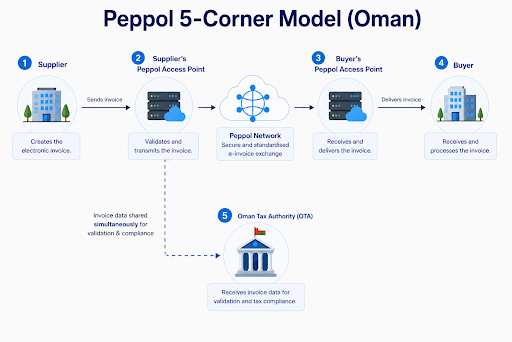
Here’s how you can generate and send an e-invoice in Oman.
Step 1: Create the Invoice On Your ERP or Accounting Software
The process begins with the supplier using their existing ERP or accounting/billing system to prepare an invoice in the prescribed format. The invoice needs to contain all the mandatory fields required by the OTA.
Step 2. Submit the Invoice to Your Access Point
The supplier then sends the invoice to its accredited Peppol Access Point. The Access Point performs all the technical checks before forwarding the invoice through the Peppol network.
Typical validations include the checking of the-
- XML structure
- Mandatory fields
- Business rule validations
- File integrity
Step 3: Exchange the Invoice Through the Peppol Network
Once validated, the invoice is securely exchanged through the Peppol network to the buyer’s Access Point. At the same time, the required invoice data is also shared with the Oman Tax Authority as part of the five-corner model.
This OTA e-invoice submission happens automatically without requiring businesses to upload invoices separately.
Step 4: The Buyer Receives the Invoice for Processing
The buyer then receives the invoice through its own Access Point. Because the invoice exchanged is already in the structured format and has undergone the necessary validations, the buyer can automatically import the data into its ERP or finance system without manual entry. This significantly reduces the processing time and minimises data entry errors.
Step 5: The OTA Performs the Required Regulatory Validations
Finally, the Oman Tax Authority receives the invoice data through the network and performs its own validation checks. Some validations carried out here include checking the invoice against the prescribed PINT OM specification, whether all mandatory data is available, and whether all applicable business rules are followed.
These checks help ensure that the invoices are compliant before they become a part of the tax reporting process.
Mandatory Fields on an Oman E-Invoice
Every e-invoice issued in Oman must contain the mandatory information prescribed by the Oman Tax Authority. Missing any of these fields could result in validation failures or invoice rejection. The checklist below covers the key mandatory information to be included in an e-invoice.
Mandatory e-Invoice Checklist
- Supplier name
- Supplier VAT Registration Number (VATIN)
- Customer name
- Customer VAT Registration Number (VATIN) (where applicable)
- Unique invoice number
- Invoice issue date
- Invoice type
- Currency
- Description of goods or services
- Quantity
- Unit price
- Taxable amount
- VAT rate
- VAT amount
- Total invoice amount
- UUID (Unique Universal Identifier)
- QR code (where applicable under OTA requirements)
Businesses should also ensure that invoice values, VAT calculations, and master data are accurate before the e-invoice is generated.
Common Errors That Lead to E-Invoice Rejection
Most invoice rejections are caused by simple mistakes rather than technical failures. Reviewing invoices before submission can save time and prevent payment delays.
Invoice Rejection Error Checklist
- Missing VAT Registration Number (VATIN) of supplier or customer
- Invalid/Inactive VAT Registration Number (VATIN) of supplier or customer
- Incorrect buyer status (B2B invoice for an unregistered entity)
- Wrong invoice format
- Invalid XML format
- Duplicate invoice number
- Incorrect date format
- Missing mandatory invoice information
- Incorrect VAT calculation
- Invalid UUID
- Incorrect tax codes
- Mismatches between invoice total amount and line-item values
- Rounding errors
- XML schema failure
- Unsupported characters
- Invoice submitted through a non-compliant system
All the above-mentioned errors can be avoided when validating invoices within the ERP/e-invoicing solution before sending them to the Fawtara network.
Conclusion
Oman's move to introduce electronic invoicing will standardise how businesses create, exchange, and report invoices. Instead of relying on manual processes, invoices will move through a secure digital network where they are validated before reaching the buyer and the Oman Tax Authority. This will ensure faster invoice processing and better tax compliance.
Businesses that prepare their systems early will transition to e-invoicing much more smoothly. The sooner your ERP and invoicing workflows are aligned with OTA requirements, the easier it will be to stay compliant when e-invoicing becomes mandatory.
Frequently Asked Questions


Cleartax is a product by Defmacro Software Pvt. Ltd.

Your data security and privacy matter most to us.