|
e-Invoicing in Philippines 2026: Timeline, Requirements, Process and Penalties


e-Invoicing in Philippines is the legal move to replace paper and PDF invoices with structured electronic files. It matters because from 31st December 2026, large taxpayers, e‑commerce firms, and CAS users must comply. The BIR EIS has set strict rules, and the penalties are heavy.
Key Takeaways
- The e-invoicing deadline for the specified taxpayers is from 31st December 2026, as per the BIR RR No. 11-2025 and 26-2025.
- Specified taxpayers are large taxpayers under BIR and EOPT Act, e-commerce businesses, and CAS/CBA users.
- E‑Invoice Philippines must be generated by the system in structured JSON format and sent to the BIR.
- You get additional tax incentives like a setup cost deduction at 100% if you are a Micro and Small taxpayer and 50% as a Medium and Large taxpayer under the CREATE MORE Act.
- If you fail to meet E-invoicing laws, you will attract a penalty of ₱1,000 to ₱50,000 per offence.
What is e-Invoicing in Philippines?
e-Invoicing in Philippines is the process of raising, sending, and storing invoices in a structured electronic format using the BIR-registered software or systems. It is not the same as a scanned paper copy or a PDF saved from a Word file. e-Invoice Philippines is a compliant e-invoice generated by the system in a machine-readable format, typically JSON. Key documents covered under the EIS include sales invoices, official receipts, service billings, debit notes, and credit notes.
The specified businesses must integrate their accounting or billing systems with the Electronic Invoicing System (EIS) in the Philippines to send invoice data directly to the BIR, without manual work.
Below laws govern Philippines e-invoicing mandates:
- e-Invoicing provisions are in the Sections 237 and 237-A of the National Internal Revenue Code (NIRC), as amended by the CREATE MORE Act.
- You can know the implementation rules primarily from the Revenue Regulations No. 11-2025 (dated 27th February 2025).
- 31st December 2026 is new e-Invoicing deadline as per the Revenue Regulations No. 26-2025 (dated 5th September 2025).
e-Invoicing Philippines Timeline (Mandatory Date 2026)
The Philippines e-Invoicing is implemented in phases. Here is the timeline from pilot to the current mandatory deadline.
Timeline / Date | Milestone |
31 December 2026 | The current deadline for Group 1 taxpayers is to issue structured e-invoices by this date |
TBD | Group 2 taxpayers (exporters, POS users, RBEs), where the deadline is yet to be announced in a separate Revenue Regulation once the BIR system is ready, except such exporter or PEZA/BOI enterprise already running SAP or Oracle is covered in the first wave, due 31 Dec 2026. |
5 September 2025 | BIR issues RR No. 26-2025, extending the compliance deadline |
14 March 2025 | RR No. 11-2025 takes effect (15 days after publication) |
27 February 2025 | BIR issues RR No. 11-2025- the primary e-invoicing regulation under CREATE MORE |
2024 | The CREATE MORE Act (RA 12066) and the EOPT Act (RA 11976) were enacted; the e-invoicing framework was significantly expanded |
November 2023 | BIR acknowledges technical challenges with the EIS; pilot effectively paused |
July 2022 | BIR launches pilot e-invoicing program for the 100 largest taxpayers (B2G transactions under RR 8-2022) |
Who Needs to Comply with e-Invoicing in the Philippines?
RR No. 11-2025 divides covered taxpayers into two groups with different obligations and timelines.
Group 1 - Mandatory Deadline: 31st December 2026
The following taxpayers must issue structured e-invoices by 31st December 2026:
- E-commerce and internet businesses- Businesses selling digital goods, digital content, online services, digital financial services, online entertainment, or conducting social/platform commerce transactions (classified as Small, Medium, or Large Taxpayers)
- Large Taxpayers under the BIR's Large Taxpayers Service (LTS)
- Large Taxpayers classified under the Ease of Paying Taxes (EOPT) Act (RA 11976) and RR No. 8-2024, generally businesses with annual gross sales exceeding PHP 1 billion
- Businesses using Computerised Accounting Systems (CAS), Computerised Books of Accounts (CBA) with electronic invoicing, or other invoicing software capable of producing structured data
Important: If a business has a head office and branch offices, all locations must comply, not just the head office.
Group 2 - No Firm Deadline Yet (Pending BIR System Readiness)
The following taxpayers will be required to comply only after the BIR establishes a system capable of storing and processing the required data. A separate Revenue Regulation will set their deadline.
- Exporters of goods and services (under Sections 106 and 108 of the Tax Code), except such exporter or PEZA/BOI enterprise already running SAP or Oracle is covered in the first wave, due 31 Dec 2026.
- Registered Business Enterprises (RBEs) availing of tax incentives under Section 304(D)
- Point-of-Sale (POS) system users
- Other taxpayers as designated by the BIR Commissioner
e-Invoicing Requirements in Philippines
To issue a compliant e-invoice, businesses must meet the following requirements under RR No. 11-2025.
1. Use EIS-Compliant Software
It's recommended to choose an EIS-compliant e-invoicing software to generate structured invoices. Your invoicing system, or any standalone billing software, must generate structured invoice data and connect to the BIR EIS via API.
Always select and evaluate your ASP against BIR's published technical specifications.
2. Obtain a Permit to Transmit (PTT)
Covered businesses must apply for EIS Certification and a Permit to Transmit (PTT) from the BIR before transmitting invoice data. Only mandated or notified taxpayers can apply.
3. Issue Invoices in Structured Format
Invoices must be in JSON format (the BIR's primary format). Alternatively, XML is also allowed but not for transmission. Plain PDFs, Word documents, and scanned paper copies do not qualify as e-invoices under RR 11-2025.
4. Include All Mandatory Fields
Every e-invoice must contain at least 54 mandatory data fields.
5. Transmit to BIR
Invoice data must be transmitted to the BIR EIS. Wave 2 will have a transmission timeline defined for 3 calendar days.
6. Maintain a Digital Archive
Businesses must keep a retrievable electronic archive of all issued invoices and transmission logs, accessible to the BIR during audits.
- Unique document ID (linked to the transaction)
- Issue date and precise timestamp
- Seller's legal name, address, and BIR TIN
- Buyer's legal name, address, and BIR TIN
- Line items for goods/services description, quantity, and unit
- Taxable value, charges, discounts, and adjustments
- VAT rate (12% VATable, 0% Zero-Rated, or VAT-Exempt)
- Tax label: 'VATables Sale', 'Zero-Rated Sale', or 'VAT-Exempt Sale'
- Grand total (including taxes)
How Philippines e-Invoicing Works: Step-by-Step Process
Step 1: Register with the BIR EIS Portal
The business registers on the BIR EIS portal and applies for EIS Certification. Only taxpayers mandated or notified by the BIR can register. Once approved, the BIR grants a Permit to Transmit (PTT).
Step 2: Integrate Your Invoicing System
Link your ERP, accounting, or billing software to the BIR EIS using a system-to-system API. You must generate structured invoice data in JSON format that is as per the BIR's invoice schema format.
Step 3: Generate the e-Invoice
When you have a transaction, the system automatically generates a structured invoice with all mandatory fields. It replaces manual paper invoices or unstructured PDF.
Step 4: Transmit Data to the BIR EIS
The invoice data is transmitted via API to the BIR EIS. The BIR platform validates the data against the prescribed schema.
Step 5: Issue the Invoice to the Buyer
Once the e-invoice is generated and transmitted, it is issued to the buyer. Both the business and buyer can access the transaction digitally for reconciliation and audit purposes.
Step 6: Archive the Records
All e-invoices and transmission logs are stored in a digital archive. Electronic records replace paper copies, subject to BIR system readiness.
Philippines e-Invoicing Model
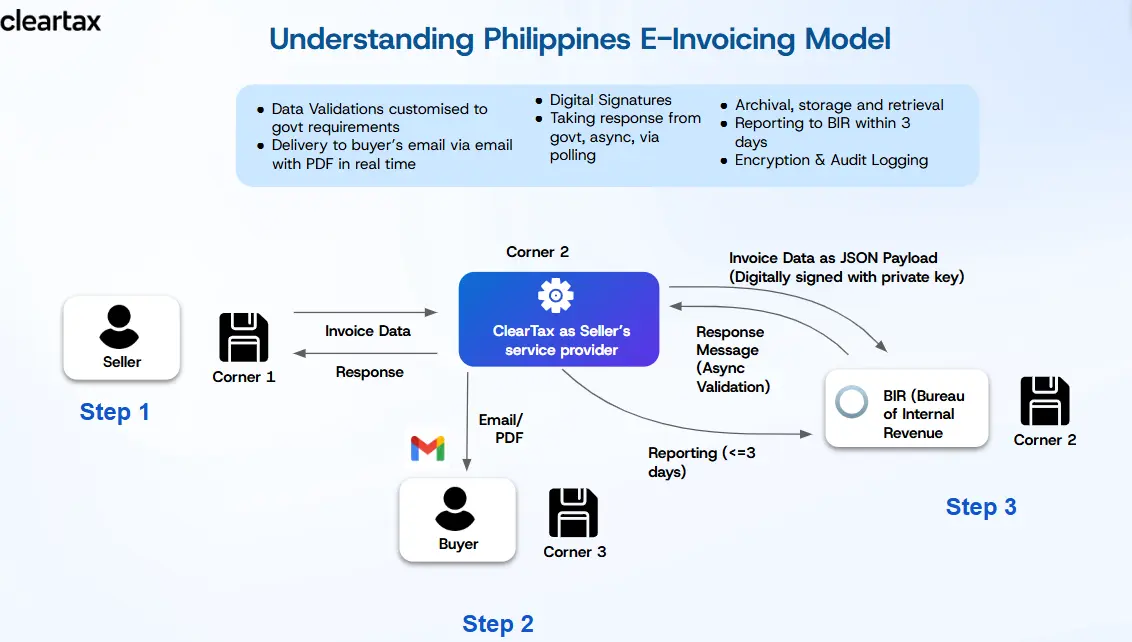
The Philippines e-invoicing framework can be understood from the chart below:
Who is Exempted from e-Invoicing?
Under RR No. 11-2025, the following taxpayers are not currently required to issue structured e-invoices:
Taxpayer Type | Status | What They Can Do Instead |
Micro Taxpayers (below the EOPT Micro threshold annual gross sales below PHP 3 million) | Exempt- mandatory requirement does not apply | Issue registered manual invoices; may voluntarily use CAS, CRM, or POS systems |
Exporters of goods and services | No firm deadline- Group 2 | Comply once BIR establishes a capable system; deadline TBD via separate RR |
Registered Business Enterprises (with tax incentives) | No firm deadline- Group 2 | Comply once BIR establishes a capable system; deadline TBD via separate RR |
POS system users | No firm deadline- Group 2 | Comply once BIR establishes a capable system; deadline TBD via separate RR |
Note: Micro Taxpayers who voluntarily adopt e-invoicing and electronic sales reporting can still claim the additional deduction on setup costs under the CREATE MORE Act.
e-Invoicing Compliance Guidelines
1. Confirm Applicability and Deadline
Verify if your business is classified as a large taxpayer, e-commerce business, CAS/CBA user, or exporter. Check whether you fall under Group 1 (31st December 2026) or Group 2 (TBD).
2. Audit Your Invoicing Infrastructure
Get a confirmation from your current ERP, billing, or accounting software provider if it can produce structured JSON invoice data and transmit it to the BIR EIS via API. Having an existing CAS accreditation does not mean EIS compliance, as they are separate systems.
3. Register with the BIR EIS
Apply for EIS Certification and a Permit to Transmit (PTT) through the BIR portal. Only mandated or notified taxpayers can apply. The BIR does not certify software vendors or evaluate solutions independently.
4. Integrate and Test Your System
Connect your invoicing software to the BIR EIS via API. Conduct end-to-end testing: invoice generation, data mapping, JSON schema validation, and transmission workflows. Resolve exceptions before the deadline.
5. Train Your Finance and IT Teams
Brief your finance, accounting, and IT staff for the new workflow.
6. Ensure All Offices Are Covered
If your business has branches, all offices must comply including the head office. Document branch readiness as part of your transition plan.
7. Maintain Clean Data Hygiene
Clean up your chart of accounts, buyer TIN records, invoice data fields, and transaction tagging before the deadline. Inaccurate master data will cause transmission failures.
Philippines e-Invoicing Penalties for Non-Compliance
Not complying with the Philippines e-invoicing mandate leads to serious financial and operational hurdles. Applicable penalties under the Tax Code are below-
Taxpayer Type | Status | What They Can Do Instead |
Micro Taxpayers (below the EOPT Micro threshold annual gross sales below PHP 3 million) | Exempt- mandatory requirement does not apply | Issue registered manual invoices; may voluntarily use CAS, CRM, or POS systems |
Exporters of goods and services | No firm deadline- Group 2 | Comply once BIR establishes a capable system; deadline TBD via separate RR |
Registered Business Enterprises (with tax incentives) | No firm deadline- Group 2 | Comply once BIR establishes a capable system; deadline TBD via separate RR |
POS system users | No firm deadline- Group 2 | Comply once BIR establishes a capable system; deadline TBD via separate RR |
Benefits of e-Invoicing for Philippine Businesses
Switching to e-invoicing offers concrete advantages, both financial and operational.
- Additional Tax Deduction (CREATE MORE Act)
Businesses that adopt e-invoicing and electronic sales reporting (mandated or voluntarily) can claim an extra deduction from taxable income: 100% of setup costs for micro and small taxpayers, and 50% for medium and large taxpayers. It is on top of the standard deduction under Section 34(A)(1) of the Tax Code. The deduction can be claimed once within the taxable year the system is completed, or the final payment is made.
- Reduced Manual Effort
Finance teams will start spending lesser time and lower manual efforts on billing, reconciliations and tax reporting since invoice generation and transmission all get automated.
- Fewer Errors
There’ll be drastic fall in human errors because of structured and consistent invoice data formats, in the areas of VAT calculations, tax reporting, and record-keeping.
- Real-Time Audit Readiness
Digital archives and transmission logs mean businesses are audit-ready at any time, reducing the risk of disputes and re-work.
- Cost Savings
Eliminating printing, physical storage, and manual data entry reduces operational costs over time.
- Faster Reconciliation
Automated invoice matching speeds up payment cycles and improves cash flow management.
- Fraud Prevention
Traceable digital records make invoice manipulation and tax evasion harder to execute.
- Exemption from Summary List of Sales (SLS)
Taxpayers using the EIS are exempt from filing the traditional Summary List of Sales, being one less periodic compliance obligation.
How ClearTax Helps to Simplify Philippines e-Invoicing Compliance?
The mandate requires covered taxpayers to issue invoices and receipts as signed JSON files and transmit them to the BIR within three days. ClearTax offers a complete e-Invoicing Software Solution that removes the need for in‑house development by finance and IT teams.
With ClearTax, businesses can:
- Easily connect with more than 60 ERPs and billing solutions such as SAP, Oracle, and Microsoft Dynamics.
- Convert invoice data into the required JSON format, apply the JWS signature, and validate each file before submission.
- Submit invoices directly to the EIS via API, with built‑in confirmation, error handling, and resubmission features.
- Store documents securely for 10 years in line with BIR requirements, with reconciliation and audit support included.
- Access CAS registration support, Permit to Transmit, and BIR testing with guidance from experts in both regulation and technology.
- Stay always compliant as ClearTax updates its platform near real-time to reflect changes in EIS rules and timelines. We have been a global e-invoicing platform across more than 50 countries since 2017. You can use a single platform to go live for e-invoicing across many countries.
Frequently Asked Questions
About the Author

Annapoorna
I preach the words, “Learning never exhausts the mind.” An aspiring CA and a passionate content writer having 8+ years of hands-on experience in deciphering jargon in Indian GST, Income Tax, off late also into the much larger global compliance ecosystem spanning SEA, GCC, USA and EU. I love curating content in various forms to the interest of tax professionals, and enterprises, both big and small. While not writing, you can catch me singing Shāstriya Sangeetha and tuning my violin ;). Read more


Clear offers taxation & financial solutions to individuals, businesses, organizations & chartered accountants in India. Clear serves 1.5+ Million happy customers, 20000+ CAs & tax experts & 10000+ businesses across India.
Efiling Income Tax Returns(ITR) is made easy with Clear platform. Just upload your form 16, claim your deductions and get your acknowledgment number online. You can efile income tax return on your income from salary, house property, capital gains, business & profession and income from other sources. Further you can also file TDS returns, generate Form-16, use our Tax Calculator software, claim HRA, check refund status and generate rent receipts for Income Tax Filing.
CAs, experts and businesses can get GST ready with Clear GST software & certification course. Our GST Software helps CAs, tax experts & business to manage returns & invoices in an easy manner. Our Goods & Services Tax course includes tutorial videos, guides and expert assistance to help you in mastering Goods and Services Tax. Clear can also help you in getting your business registered for Goods & Services Tax Law.
Save taxes with Clear by investing in tax saving mutual funds (ELSS) online. Our experts suggest the best funds and you can get high returns by investing directly or through SIP. Download Black by ClearTax App to file returns from your mobile phone.
Cleartax is a product by Defmacro Software Pvt. Ltd.

ISO 27001
Data Center

SSL Certified Site
128-bit encryption