
POPULAR ARTICLES
- Top E-Invoicing Service Providers in UAE: FTA Approved List
- UAE e-Invoicing Frequently Asked Questions (FAQs)
- How to Choose Your UAE E-Invoicing Technology Partner
- SAP UAE E-Invoicing Integration for SAP S/4HANA, ECC & SAP Business One
- List of ERP Changes Required for UAE E-Invoicing Compliance
- AP e-Invoicing in UAE: How Buyers Receive and Process E-Invoices?
- API, Middleware & ERP Integration for UAE E-Invoicing
RELATED ARTICLES
- e-Invoicing in UAE: Key Requirements, Implementation Timeline & Latest Updates
- What is the Peppol CTC Model in UAE for E-Invoicing?
- UAE e-Invoicing Frequently Asked Questions (FAQs)
- UAE Tax Credit Note: Examples, Formats & Benefits
- Digital Signature Certificate in UAE: Benefits, Process & How It Works
- VAT Invoice in UAE: Mandatory Details & Format
- VAT Rate List in UAE
- How to Claim VAT Refund in UAE?
- What are the Penalties for Non-Compliance under the UAE VAT?
- TRN Verification in UAE: Step-by-Step Process to Verify VAT Number in UAE
- Excise Registration in UAE: A Comprehensive Guide
YOU MIGHT BE INTERESTED IN
How to Get Your UAE E-Invoicing Endpoint ID & Register on EmaraTax


UAE e-invoicing is no longer a distant roadmap project. It is a live compliance reality that demands immediate attention. To trade under the new regime, you must use a Participant Identifier (Endpoint ID) derived from your 10-digit Tax Identification Number (TIN). Registration happens via EmaraTax, where you formally appoint an Accredited Service Provider to manage your Peppol transmissions.
Key Takeaways
- Your unique identifier follows the format 0235: [10-digit TIN]. This acts as your digital letterbox for all invoice traffic.
- You must complete the registration on the official EmaraTax portal. An ASP cannot legally perform this specific action for you.
- You are required to use the same service provider for both Accounts Payable (AP) and Accounts Receivable (AR). This ensures a clean audit trail.
- Large taxpayers with revenue over AED 50 million must appoint an ASP by 31 July 2026. Delaying this will lead to heavy non-compliance penalties.
What is the UAE Participant Identifier (Endpoint ID)?
The UAE Participant Identifier, or Endpoint ID, is your business's unique digital letterbox on the Peppol network, structured as the prefix 0235: followed by your 10-digit TIN. Without this specific identifier, the decentralised e-invoicing system cannot route your XML invoices to the correct recipient, making it the most critical component of your digital trade identity. It ensures that every transaction is mapped to the correct legal entity within the Federal Tax Authority’s (FTA) monitoring framework.
Below is the format:
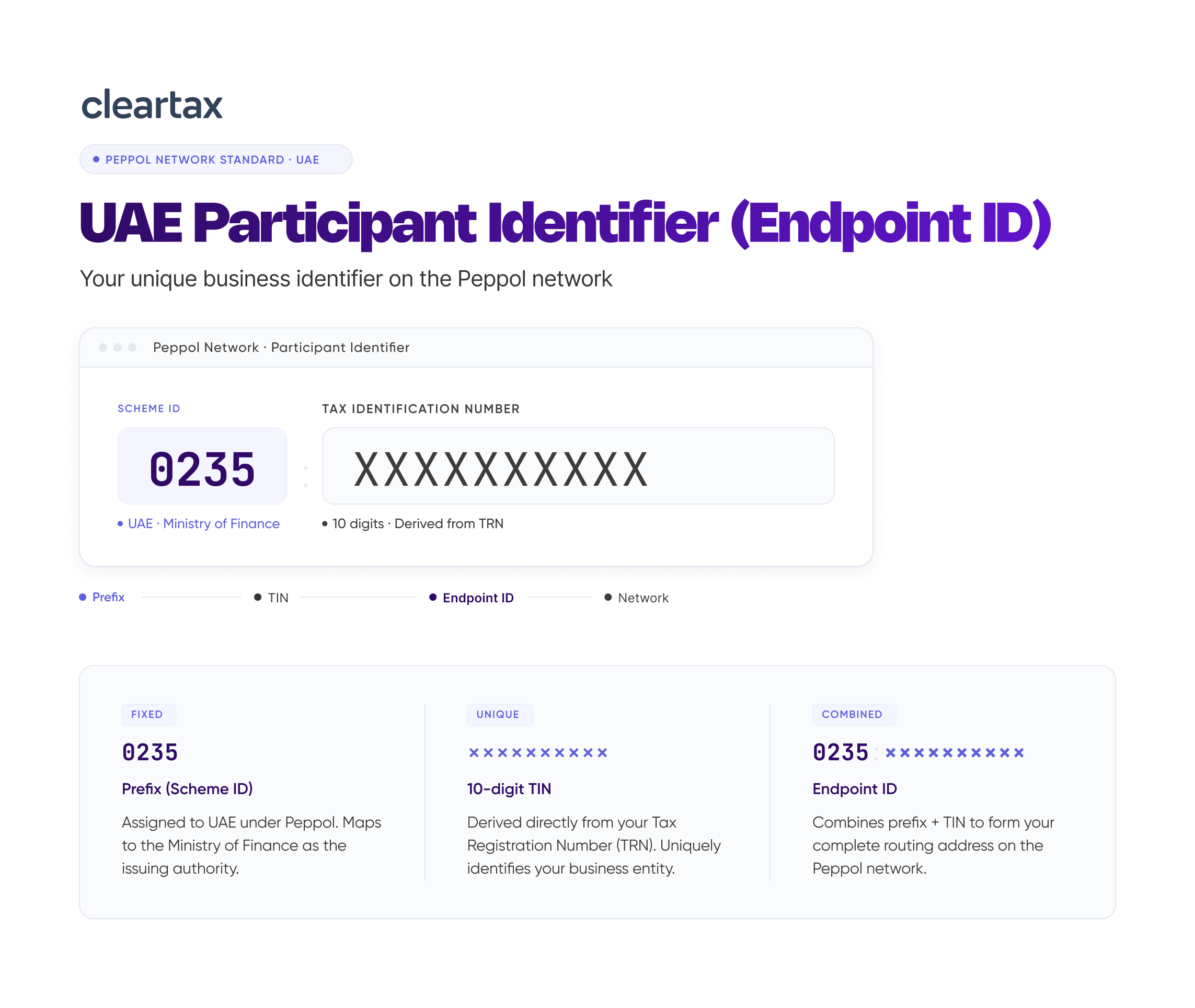
The UAE adheres to the ISO 6523 standard. For every business registered here, the scheme code is 0235. This code identifies the UAE FTA as the primary issuing body. Your specific address within this scheme is your TIN. You should note that this is not your 15-digit TRN. The TIN used for e-invoicing consists strictly of the first 10 digits of your registration.
How to Derive the Endpoint ID - Step by Step
You do not actually ‘apply’ for an Endpoint ID. Instead, you derive it from the tax credentials you already possess. If you are already registered for Corporate Tax, you have what you need.
Step 1-Locate your TRN/TIN: Review your tax registration certificate and pull the first 10 digits.
Step 2-Verify the Check Digit: The 10th digit is a check digit. It is calculated using the Luhn algorithm. If you fail to validate this, you will see immediate transmission errors in your system.
Step 3-Prefix the Scheme Code: You must combine the UAE identifier with your 10-digit number. Format: 0235:1234567890
Step 4-Confirm in the Peppol Directory: Once your ASP activates your profile, your business becomes searchable in the global Peppol Directory.
How to Register via EmaraTax - Onboarding Process
The Ministry of Finance (MoF) stipulates that while ASPs manage the technical infrastructure, the taxpayer remains responsible for granting permissions.
The Onboarding Flow
Step 1-Access the Portal: Log in to your EmaraTax account using your corporate credentials or UAE PASS. If you do not have a TIN yet, you must obtain one first, as it serves as your primary address on the e-invoicing network.
Step 2-Monitor the July 2026 Launch: Navigate to the e-invoicing dashboard. The formal Pilot Phase starts on 1 July 2026. This is when you can officially link your account if you choose to be an early adopter.
Step 3-Appoint Your ASP: Select your partner from the official MoF Accredited Service Provider list within the dashboard. You can only appoint one ASP to handle both your incoming and outgoing invoices.
Step 4-Meet the 31 July 2026 Deadline: If you are a large taxpayer (>AED 50 M annual revenue), you must appoint an ASP by 31 July 2026. If you miss this date, you face an automatic monthly penalty of AED 5,000.
Step 5-Generate Your Secure Token: Once you select your provider, the portal generates a secure integration token. You give this digital key to your ASP so they can connect your ERP system (like SAP or Oracle) to the FTA’s network.
Step 6-Activate Your ID: After your ASP establishes the link, they activate your Peppol Participant ID (0235: TIN). You are now live on the network and can exchange compliant XML invoices with your customers and suppliers.
Why Must Each Entity Use a Single ASP for Both AP and AR?
The UAE uses a Decentralised Continuous Transaction Control (DCTC) model. This requires a 360-degree view of your tax positions. If you try to use different ASPs for your sales and your purchases, you create a fragmented data stream.
Fragmentation is where most tax audits begin. By mandating a single ASP, the government ensures that your incoming and outgoing data match in near real-time. This rule also saves you from the logistical nightmare of managing multiple API integrations and different support desks when a transmission fails.
Predefined Endpoints for Non-Onboarded Buyers
There will be cases where you are ready to send an e-invoice, but your buyer is lagging behind. You cannot stop billing just because they are not yet onboarded.
The MoF has provided for "Predefined Endpoints." If your buyer is in the UAE but is not yet active on the Peppol network, your ASP routes the invoice to a default state. This allows the FTA to keep their records. However, your ASP will route the invoice using the predefined code 0235:9900000098 for domestic buyers not yet on the network.
The shift to Endpoint IDs and EmaraTax registration marks the end of an era for paper and PDF invoicing in the Emirates. While these technical requirements are very specific, the automation you gain is worth the setup effort. If you are a large entity, do not wait for the January 2027 deadline. You should use the 2026 pilot phase window to get your records in order.
Frequently Asked Questions
About the Author

Rajan Rauniyar
I’m a Senior Content Writer at ClearTax, specializing in e-invoicing, VAT, and Tax compliance. Over the years, I’ve researched and written everything from blog posts to whitepapers and product guides, helping ClearTax expand in Malaysia, KSA, UAE, Singapore, Belgium, France and beyond. My goal is to write the most comprehensive, understandable, readable, and accurate content on any topic that has ever existed on the internet. Read more


Cleartax is a product by Defmacro Software Pvt. Ltd.
Your data security and privacy matter most to us.