
e-Invoicing in USA: Requirements, Formats, Guidelines & Process


e-Invoicing in the USA is the exchange of structured invoice data between businesses through a digital network, not a PDF by email. Unlike most of the world, the US has no federal mandate. Adoption stays voluntary, driven by the DBNAlliance framework. Here's what enterprise finance teams really need to know before 2027.
Key Takeaways
- e-Invoicing in the USA is voluntary. The United States does not have a federal B2B e-invoicing mandate, and no e-invoicing US mandatory date exists on the books.
- Federal suppliers are the exception. B2G invoicing must be electronic.
- The DBNAlliance runs a Peppol-style network for voluntary B2B exchange.
- Common formats are X12 EDI and UBL.
- Early adopters win on payment speed and cost, not compliance.
What is e-Invoicing in the USA?
e-Invoicing in the USA means sending and receiving invoices as structured data that software reads automatically. A scanned PDF or a Word file does not count. The data moves machine to machine, usually across a shared network, so both sides skip manual entry. Think of it as a common language for invoices, not a document you eyeball.
Is e-Invoicing Mandatory in the USA?
No. There is no federal or state mandate for B2B e invoicing in the USA. That's the big difference from Europe, Latin America and much of Asia. One exception: federal agencies have been directed to use electronic invoicing for procurement since 2015, mostly through the Treasury's Invoice Processing Platform. So the honest answer on any e-invoicing US mandatory date is that none exists yet for private trade.
e-Invoicing in USA Timeline
Year | What happened |
| 2015 | Federal agencies directed to accept electronic invoices for procurement (B2G) |
| 2022 | BPC and Federal Reserve run the e-invoice pilot in three waves |
| 2023 | DBNAlliance formed as the legal entity overseeing the exchange framework |
| 2024 | First live invoice sent across the DBNAlliance network in April |
| 2025–26 | Voluntary adoption grows; still no B2B mandate |
Who Needs to Comply with e-Invoicing in the USA?
Right now, almost nobody is forced to. The one group with a real obligation is suppliers to the federal government. Everyone else chooses. That said, large retailers and manufacturers often push EDI onto their suppliers by contract, so plenty of firms already comply without a law telling them to.
e-Invoicing Requirements in USA
Because there's no mandate, there's no single legal checklist. In practice, an electronic invoicing USA setup needs a structured format (UBL or EDI), an access point if you use the DBNAlliance network, and records kept for the IRS. Federal suppliers must also meet their agency's portal rules. That's it.
How USA e-Invoicing Works: Step-by-Step Process
- Step 1: Your e invoicing software creates the invoice as structured data.
- Step 2: Your access point validates and formats it.
- Step 3: It travels across the network to your customer's access point.
- Step 4: Their system ingests it straight into accounts payable.
- Step 5: Both sides archive the record.
This follows a four-corner model, the same idea Europe's Peppol uses.
USA e-Invoicing Framework
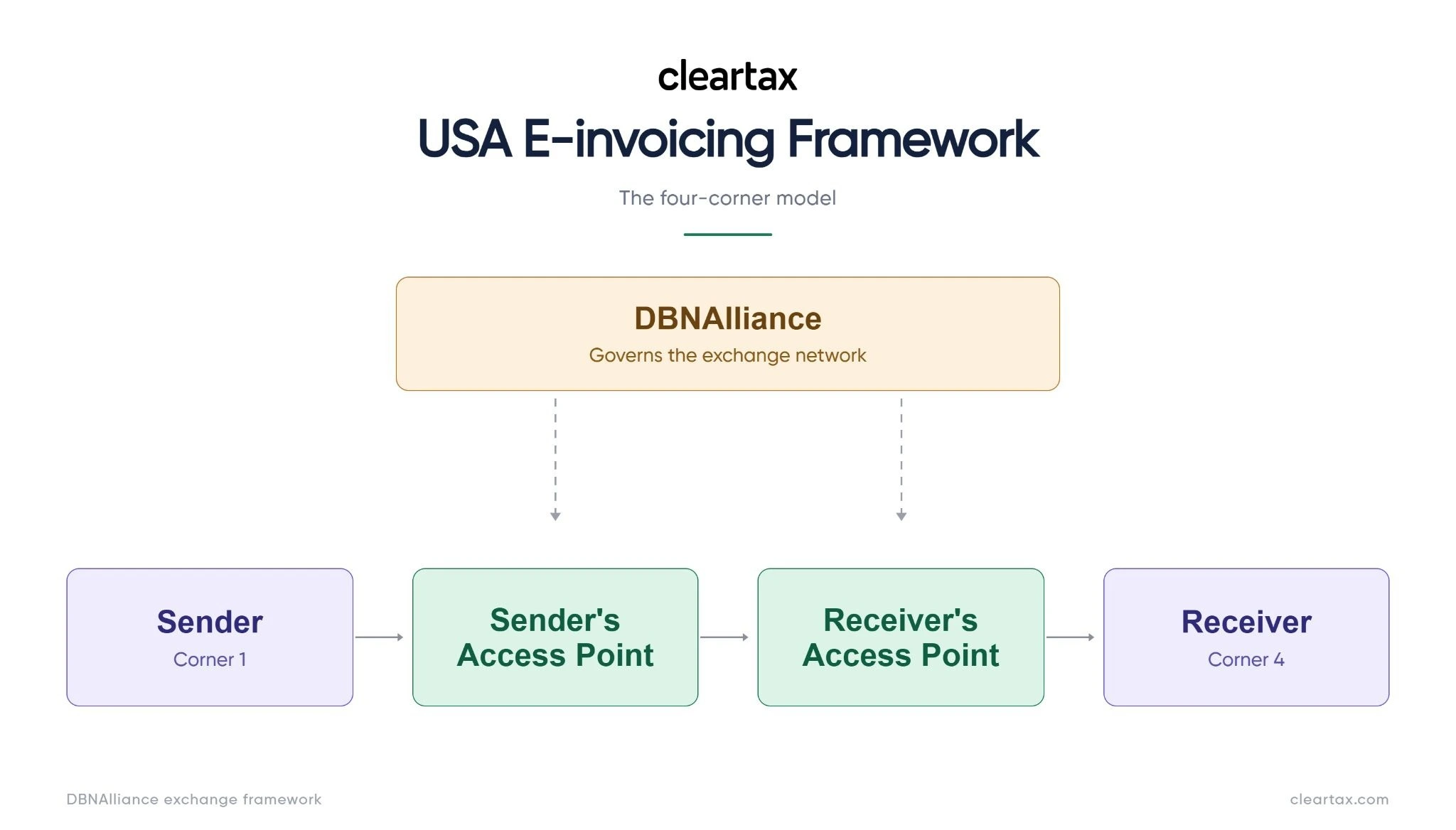
The DBNAlliance runs this framework. A business selects an access point through which invoices are exchanged, then reaches anyone else on the network. No point-to-point deals with every trading partner.
Who is Exempted from e-Invoicing in USA?
Since participation is voluntary, exemption isn't really the right word. No private business is compelled, so all are effectively exempt from a B2B rule. Federal suppliers are the exception and cannot opt out of their agency's electronic requirement.
US e-Invoicing Compliance Guidelines
Keep it simple. Pick a format your partners accept. Use a certified access point if you join the DBNAlliance. Retain invoices for the IRS window. And check contract terms with big buyers, because their EDI rules often bite harder than any government one.
Benefits of e-Invoicing for US Businesses
- Faster payment cycles, fewer disputes.
- Lower processing cost per invoice.
- Fewer manual errors.
- A cleaner audit trail.
The payment speed is usually what wins finance teams over.
USA e-Invoicing Penalties for Non-Compliance
There are none at federal level for skipping e invoicing. There are no federal penalties for not using e-invoicing in the United States. You cannot be fined for using paper in B2B trade. The only real exposure is commercial: a federal contract or a large customer may drop you if you can't exchange invoices their way.
e-Invoicing Formats & Standards in the USA
Standard | Where it's used |
| X12 EDI | Legacy, still dominant among large US enterprises |
| UBL (OASIS) | DBNAlliance network, cross-border friendly |
| UN/CEFACT CII | Less common, international trade |
There's no single national e invoice login or government portal for B2B, which surprises a lot of firms arriving from Europe.
How can ClearTax Help a Business with e-Invoicing in the USA?
ClearTax, a reliable global e-invoicing solution provider, that could help businesses comply with e-invoicing:
- Seamless ERP & POS Integration: Invoices are sent automatically and routed over the designated network, ensuring compatibility with local requirements.
- Real-Time Compliance Verifications: Validates invoices against local regulations and invoice formats.
- Cloud-Based e-Invoicing Portal: Facilitates easy monitoring, reconciliation, and management of e-invoices.
- Automated Compliance and Reporting Alerts: These alerts keep businesses updated with the latest regulations, minimising the risks of delays and inaccuracies.
Conclusion
The US is the odd one out: strong infrastructure, no mandate. For enterprise finance teams, the smart move is to adopt e invoicing now for the cash-flow and cost wins, not because a law forces you. When the rules shift, and they might, you'll already be running.
Frequently Asked Questions
About the Author

Annapoorna
I preach the words, “Learning never exhausts the mind.” An aspiring CA and a passionate content writer having 8+ years of hands-on experience in deciphering jargon in Indian GST, Income Tax, off late also into the much larger global compliance ecosystem spanning SEA, GCC, USA and EU. I love curating content in various forms to the interest of tax professionals, and enterprises, both big and small. While not writing, you can catch me singing Shāstriya Sangeetha and tuning my violin ;). Read more


Your data security and privacy matter most to us