e-Invoicing in Ireland: Timeline, Guidelines, Process, and Steps for Implementation
Updated on: Jul 14th, 2026
|
22 min read


e-Invoicing in Ireland is shifting from voluntary to mandatory. Public bodies have accepted structured e-invoices since 2019, but Budget 2026 confirmed mandatory B2B e-invoicing and real-time VAT reporting from November 2028, aligned with the EU's ViDA rules. This guide covers the timeline, who must comply, the process, requirements, penalties and how to prepare.
Key Takeaways
- e-Invoicing in Ireland means structured, machine-readable invoices to the EN 16931 standard, usually over Peppol. A PDF or scan does not count.
- B2G e-invoicing has applied since 2019. Public bodies must be able to receive e-invoices; suppliers issue them voluntarily.
- Mandatory B2B e-invoicing and real-time VAT reporting begin on 1 November 2028, starting with large corporates.
- From that same date, every business must be able to receive a structured e-invoice, whatever its size.
- The obligation widens to intra-EU traders on 1 November 2029, ahead of full EU ViDA rules on 1 July 2030.
What is e-Invoicing in Ireland?
E-invoicing in Ireland involves issuing and exchanging invoices in a structured, machine-readable format that another system can process automatically, without anyone rekeying the data. The format follows the European standard EN 16931, usually carried as XML over the Peppol network. A scanned paper invoice or a PDF sent by email does not meet that definition. Revenue has been explicit on this. Issuing PDFs or scanned documents will not satisfy the coming e-invoicing requirements.
Two systems currently run side by side. Business-to-government (B2G) e-invoicing has been in place since 2019, where public bodies must be able to receive structured invoices but suppliers are not forced to send them. Business-to-business (B2B) e-invoicing is the new piece, arriving in phases from 2028, and here issuing will become mandatory for businesses in scope. The rest of this guide keeps the two apart, because the obligations are different.
Ireland e-Invoicing Compliance Timeline (Deadlines)
The e-invoicing timeline in Ireland has two chapters. The first is the public procurement story that started years ago. The second is the VAT modernisation programme that will affect ordinary trading businesses.
Date | What happens |
12 June 2019 | SI 258/2019 takes effect. Public bodies must be able to receive EN 16931 e-invoices via Peppol. Suppliers issue voluntarily. |
October 2023 | Revenue opens public consultation on modernising VAT administration. |
June 2024 | Consultation findings published. |
11 March 2025 | EU adopts the ViDA Directive. |
8 October 2025 | Revenue publishes "VAT Modernisation: Implementation of eInvoicing in Ireland". |
10 February 2026 | Revenue confirms the "large corporate" scope for Phase 1. |
1 November 2028 | Phase 1. Large corporates must issue e-invoices and report data in real time for domestic B2B. All businesses must be able to receive structured e-invoices. |
1 November 2029 | Phase 2. The obligation extends to all VAT-registered businesses in intra-EU B2B trade. |
1 July 2030 | Phase 3. Full ViDA compliance for all cross-border intra-EU B2B transactions. |
Who Needs to Comply with e-Invoicing in Ireland?
Compliance depends on whether the transaction is B2G (Business-to-Government) or B2B (Business-to-Business), and when the mandate applies.
Business-to-Government (B2G)
- Public sector bodies must be able to receive and process EN 16931-compliant e-invoices.
- Suppliers may issue structured e-invoices voluntarily. It is not mandatory.
Business-to-Business (B2B)
From 1 November 2028:
- Businesses whose tax affairs are managed by the Revenue Large Corporates Division, and that are established or have a fixed establishment in Ireland, must issue structured e-invoices.
- All businesses must be able to receive structured e-invoices.
From 1 November 2029:
- All VAT-registered businesses making eligible intra-EU B2B supplies must issue structured e-invoices and comply with digital reporting requirements.
From 1 July 2030:
- Full compliance with the EU's ViDA framework for cross-border intra-EU B2B transactions becomes mandatory.
Ireland e-Invoicing Compliance Guidelines
- Authorities:
The Office of Government Procurement (OGP) oversees B2G e-invoicing and serves as Ireland's Peppol Authority. Revenue leads the B2B e-invoicing and VAT modernisation programme.
- Invoice format:
E-invoices must comply with EN 16931 and are typically exchanged using Peppol BIS Billing 3.0 over the Peppol network. PDFs and scanned invoices are not considered e-invoices.
- Digital signatures:
Not mandatory. Businesses can ensure authenticity and integrity through business controls, EDI, or advanced electronic signatures.
- Record retention:
VAT records, including e-invoices, must generally be retained for six years and made available to Revenue upon request.
- Future technical specifications:
Revenue will publish detailed technical guidance before each implementation phase. Businesses should begin preparing early by assessing ERP readiness, cleaning master data, and selecting a Peppol Access Point rather than waiting for the final specifications.
e-Invoicing Requirements in Ireland
To comply with Ireland's e-invoicing framework, businesses must meet both invoice content and transmission requirements. The key requirements are outlined below:
Invoice Content Requirements
Include all mandatory fields under the VAT Consolidation Act 2010, including:
- Invoice issue date
- Unique sequential invoice number
- Supplier's name, address, and VAT number
- Customer details (where applicable)
- Description of goods or services
- VAT-exclusive amount
- Applicable VAT rate
- VAT amount payable
Invoice data must be in a structured, machine-readable format, not as plain text or a PDF.
Transmission Requirements
- Issue invoices in an EN 16931-compliant structured electronic format, typically XML.
- Exchange invoices through an accredited Peppol Access Point, rather than by email.
- For transactions covered by ViDA, issue cross-border e-invoices within 10 days of the chargeable event and report the required data digitally to the tax authority.
- Revenue will publish detailed technical specifications ahead of each implementation phase.
Implementation Readiness
- Choose a Peppol Access Point.
- Clean and validate customer and VAT master data.
- Ensure your ERP or accounting system can generate EN 16931-compliant e-invoices.
- Start preparations early instead of waiting for the final technical specifications.
How Ireland e-Invoicing Works: Step-by-Step Process
Here is the practical sequence a supplier follows to issue a compliant e-invoice in Ireland.
Issuing a compliant e-invoice in Ireland follows a straightforward process. Here's how it works:
Step 1: Validate Invoice Data
Ensure the invoice contains all mandatory fields required under Irish VAT law. It is also important to clean and validate customer and VAT master data before issuing invoices.
Step 2: Generate a Structured e-Invoice
Create the invoice in an EN 16931-compliant structured format, typically Peppol BIS Billing 3.0, using your ERP or accounting system.
Step 3: Connect to the Peppol Network
Register with an accredited Peppol Access Point so your business can send and receive e-invoices through the network.
Step 4: Send the e-Invoice
Transmit the structured invoice through your Peppol Access Point, which securely routes it to the recipient's Access Point.
Step 5: Invoice Validation and Delivery
The recipient's Access Point validates the invoice format and delivers it directly into the recipient's accounting or ERP system.
Step 6: Report Invoice Data to Revenue (B2B Only)
For transactions covered under the B2B mandate, the required invoice data is reported to Revenue in near real time alongside invoice transmission.
Step 7: Archive the Invoice
Store the e-invoice and its transmission records for at least six years, ensuring they remain accessible, legible, and unaltered for audit purposes.
Note: For B2G e-invoicing, the current process includes Steps 1 to 5 and Step 7. The reporting step in 6 belongs to the new VAT modernisation regime.
Ireland e-Invoicing Framework
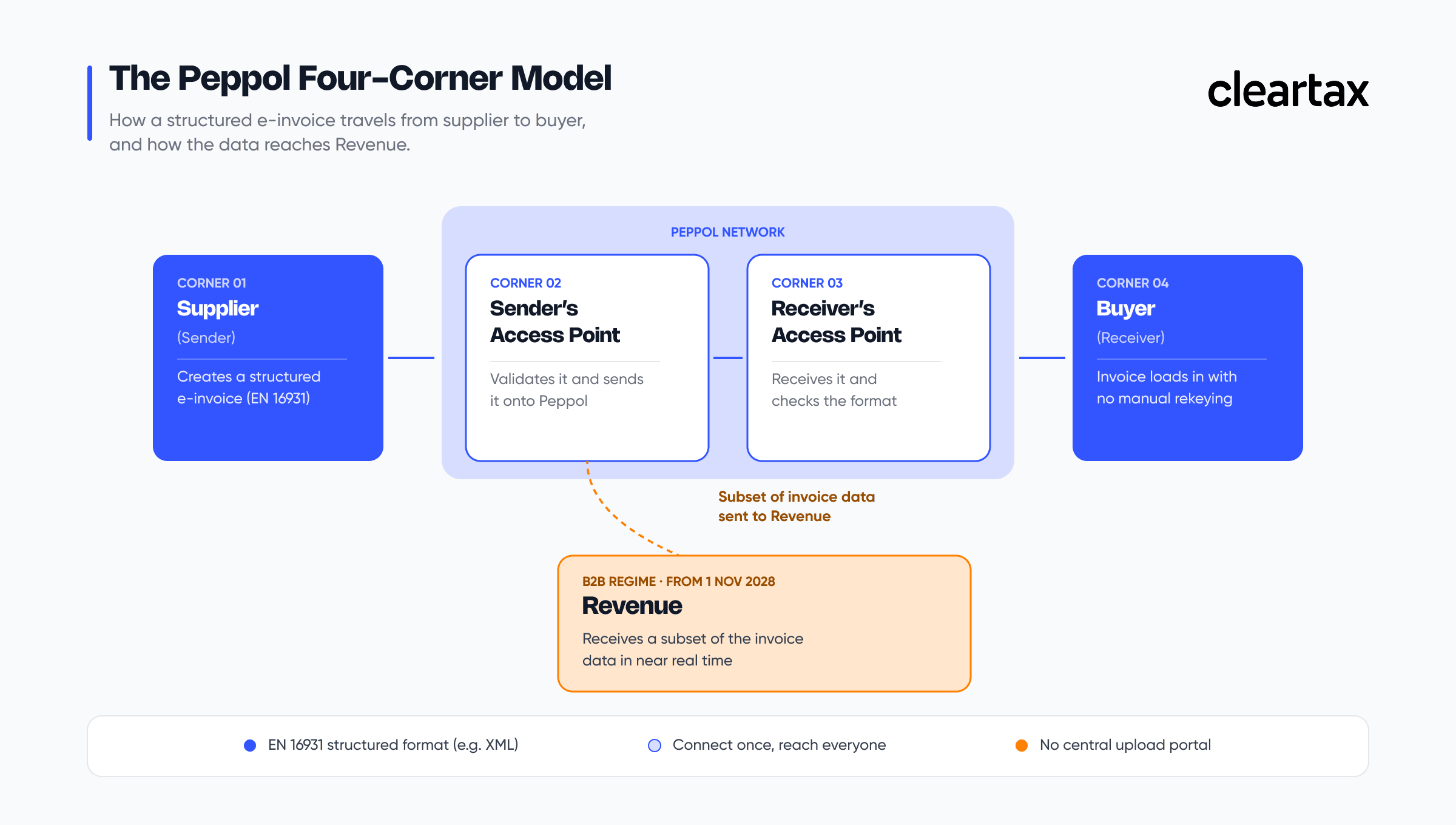
Benefits of e-Invoicing in Ireland
Businesses adopting e-invoicing in Ireland can benefit from greater efficiency, improved compliance, and better financial visibility. Key benefits include:
- Less manual work: Eliminates manual data entry by enabling invoices to flow directly between business systems.
- Fewer errors: Reduces keying mistakes and missing information that can lead to invoice disputes or payment delays.
- Faster invoice processing: Automates invoice exchange and validation, helping speed up processing and approvals.
- Quicker VAT repayments: Revenue can process VAT repayment claims faster using real-time invoice data.
- Reduced compliance risk: Real-time reporting enables Revenue to focus on genuine risks, reducing routine interventions for compliant businesses.
- Better business insights: Structured invoice data improves cash flow visibility, forecasting, and financial reporting.
- Smoother regulatory transition: Businesses that prepare early can adapt more easily to the upcoming e-invoicing mandate and avoid last-minute implementation challenges.
Ireland e-Invoicing Penalties for Non-Compliance
Non-compliance | Penalty / Consequence |
Failure to comply with VAT invoicing requirements | Fixed penalty of €4,000 under the VAT Consolidation Act 2010 |
Failure to maintain proper books and records | Fixed penalty of €4,000 |
Failure to file a VAT return | Fixed penalty of €4,000 |
Late payment of VAT | Interest of approximately 0.0274% per day (around 10% annually) |
Incorrect VAT returns | Tax-geared penalties depending on whether the error is considered careless or deliberate |
Non-compliant B2G e-invoices | Public bodies may reject the invoice, resulting in delayed payments and possible contractual issues |
Poor data quality under real-time reporting | Errors such as incorrect VAT numbers or customer details may be identified immediately, increasing the risk of compliance issues and invoice rejections |
How can ClearTax Help a Business with e-Invoicing in Ireland?
ClearTax, a reliable e-invoicing solution provider, that could help businesses comply with e-invoicing:
- Seamless ERP & POS Integration: Invoices are sent automatically and routed over the Peppol network, ensuring compatibility with Irish public sector requirements.
- Real-Time Compliance Verifications: Validates invoices against Irish regulations, such as Peppol BIS and CIUS-CEFACT formats.
- Cloud-Based e-Invoicing Portal: Facilitates easy monitoring, reconciliation, and management of e-invoices.
- Automated Compliance and Reporting Alerts: These alerts keep businesses updated with the latest regulations, minimising the risks of delays and inaccuracies.
Frequently Asked Questions


Clear offers taxation & financial solutions to individuals, businesses, organizations & chartered accountants in India. Clear serves 1.5+ Million happy customers, 20000+ CAs & tax experts & 10000+ businesses across India.
Efiling Income Tax Returns(ITR) is made easy with Clear platform. Just upload your form 16, claim your deductions and get your acknowledgment number online. You can efile income tax return on your income from salary, house property, capital gains, business & profession and income from other sources. Further you can also file TDS returns, generate Form-16, use our Tax Calculator software, claim HRA, check refund status and generate rent receipts for Income Tax Filing.
CAs, experts and businesses can get GST ready with Clear GST software & certification course. Our GST Software helps CAs, tax experts & business to manage returns & invoices in an easy manner. Our Goods & Services Tax course includes tutorial videos, guides and expert assistance to help you in mastering Goods and Services Tax. Clear can also help you in getting your business registered for Goods & Services Tax Law.
Save taxes with Clear by investing in tax saving mutual funds (ELSS) online. Our experts suggest the best funds and you can get high returns by investing directly or through SIP. Download Black by ClearTax App to file returns from your mobile phone.
Cleartax is a product by Defmacro Software Pvt. Ltd.

ISO 27001
Data Center

SSL Certified Site
128-bit encryption